
If you are trying to cut food bills and energy bills in 2026, you are probably asking a very sensible question: should you buy a halogen oven or an air fryer?
In the UK, this is no longer just a gadget question. It is a household budgeting question.
For many people, especially smaller households, over-50s, busy couples, and anyone trying to avoid turning on a full-size oven every evening, compact cookers can make a real difference. But the answer is not as simple as “air fryers are always cheaper.” In some situations, that is true. In others, a halogen oven can quietly be the better-value choice. The real winner depends on how you cook, how often you cook, and how many people you are feeding.
As of 1 January to 31 March 2026, the average electricity unit rate under Ofgem’s energy price cap for direct debit customers is 27.69p per kWh, with an average daily electricity standing charge of 54.75p. Ofgem has also announced that from 1 April to 30 June 2026, the average electricity unit rate will fall to 24.67p per kWh, although standing charges will rise slightly on average. That means efficient cooking still matters, but the maths can shift a little depending on when you read this and what tariff you are on.
So let’s make this practical.
This guide compares running costs, upfront cost, cooking speed, portion size, everyday convenience, and best use cases for UK households in 2026. By the end, you will know which appliance is likely to save you more money — and which one makes more sense for your kitchen.
Why this comparison matters in 2026
The reason this debate matters is simple: many UK households are still looking for ways to control energy use without making daily life harder. Ofgem updates the energy price cap every three months, which means the cost of electricity can move over the year rather than staying fixed forever. That makes appliance efficiency more important than many people realise, especially for homes that cook frequently.
A compact cooking appliance usually saves money compared with using a large conventional oven because it heats a smaller space and often cooks food faster. But “compact” does not automatically mean “cheapest.” A single-drawer air fryer, a dual-drawer air fryer, and a halogen oven do not all behave the same way. Their wattage, cooking time, capacity, and real-life usage patterns are different. Manufacturer specifications across current UK products show that single air fryers commonly sit around 1500W to 2000W, dual-zone air fryers often reach around 2400W to 2470W, while halogen ovens commonly sit around 1300W to 1400W.
That is where the real question begins.
What is a halogen oven?
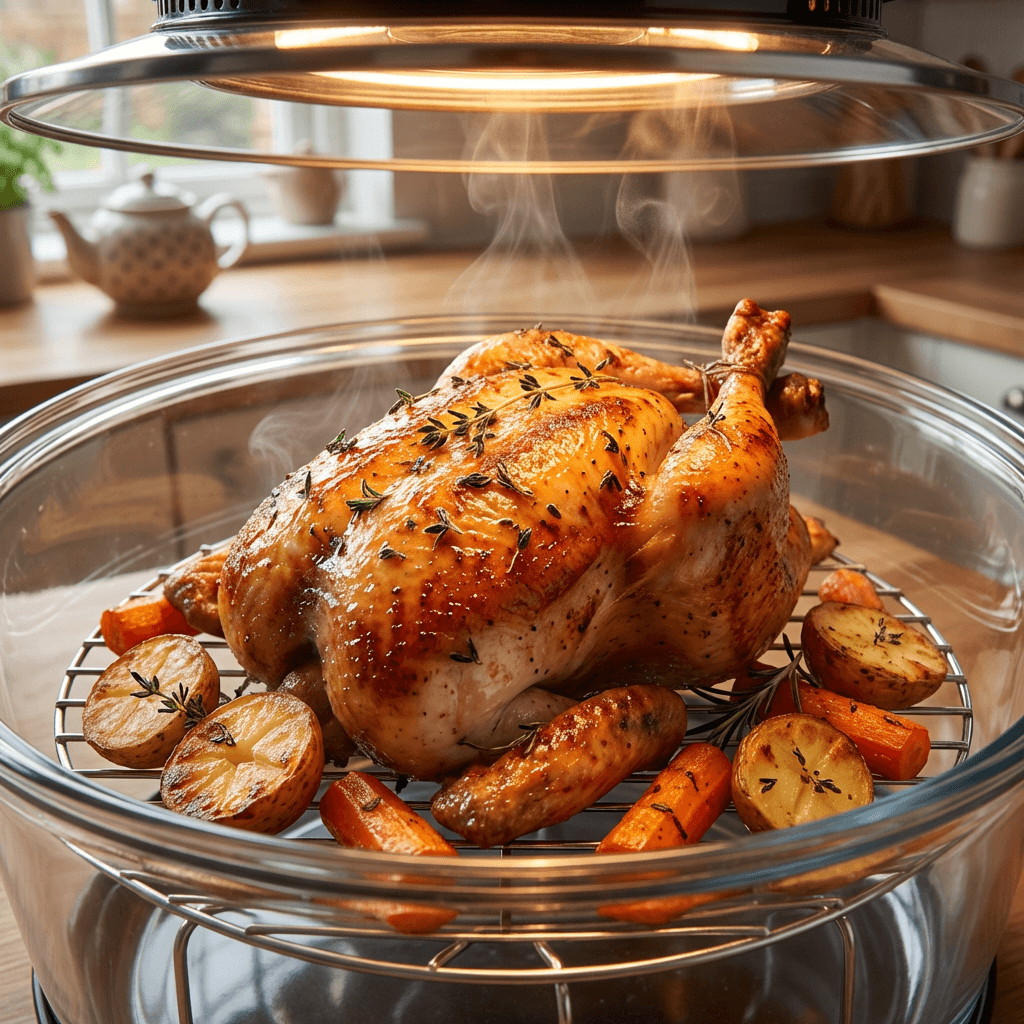
A halogen oven is a countertop cooker with a glass bowl, a lid containing a halogen heating element, and a fan that circulates hot air. In other words, it is a kind of hot-air cooker too — but with a different design from the drawer-based air fryer most people picture today. UK retailers currently list common halogen models at around 17 litres capacity and roughly 1300W to 1400W.
Its biggest strengths are usually these:
- lower upfront purchase price
- larger visible cooking chamber
- good capacity for roasts, trays, and batch cooking
- simple controls on many budget models
Its weaknesses are also familiar:
- bulkier shape
- less fashionable, so fewer accessories and recipes
- can be less convenient for very quick snack-style cooking
- some people dislike lifting the hot lid
In plain English, a halogen oven often feels like a budget-friendly, practical family workhorse rather than a trendy countertop gadget.
What is an air fryer?
An air fryer is also a hot-air cooker, but most modern UK models use a compact basket or drawer design. Current products on the UK market range from small single-drawer units around 1500W to 1700W, up to larger family models around 2000W, and dual-zone versions around 2400W to 2470W.
Its main strengths are usually:
- fast cooking for smaller portions
- excellent crisping
- easy weeknight convenience
- preset programmes
- strong fit for reheating, chips, frozen foods, chicken, vegetables and quick meals
Its weak points are different:
- good models are more expensive
- drawer space can be awkward for larger items
- dual models can draw a lot of power when both zones run together
- for batch cooking, the cost advantage can shrink
So while air fryers are often sold as the money-saving hero, the details matter.
Upfront cost: halogen oven usually wins easily
If your goal is to spend less money overall, you should never ignore the purchase price.
In March 2026, a 17L halogen oven is easy to find in the UK at around £49.99. By contrast, a recognised-brand single air fryer such as the Ninja MAX PRO 6.2L is listed at £129.99, while a dual-zone air fryer can sit at £149.99 to £199.99 or more depending on retailer and model.
That means a halogen oven can cost roughly:
- about £80 less than a branded single air fryer
- about £100 to £150 less than many dual air fryers
For a budget-conscious UK household, that is not a small difference. Even if an air fryer saves a few pence more on certain meals, it may take a long time to recover that extra upfront cost.
This is one of the most overlooked parts of the debate.
Running costs: the maths people actually care about
Let’s now look at the question everyone asks: which one is cheaper to run?
The simple formula is:
Power in kW × cooking time in hours × electricity price per kWh
Using Ofgem’s current average electricity figure for January to March 2026 — 27.69p per kWh — we can build realistic examples.
Example 1: a typical halogen oven meal
Let’s use a 1400W halogen oven cooking for 35 minutes.
- 1400W = 1.4kW
- 35 minutes = 0.583 hours
- energy used = 0.816kWh
- cost at 27.69p/kWh = about 22.6p
That is a very reasonable cooking cost for a family-sized or roast-style meal.
Example 2: a typical single air fryer meal
Now let’s use a 1700W air fryer cooking for 20 minutes.
- 1700W = 1.7kW
- 20 minutes = 0.333 hours
- energy used = 0.566kWh
- cost at 27.69p/kWh = about 15.7p
For smaller meals, the air fryer often wins. It uses more power per hour than some halogen ovens, but it usually cooks faster, so the total cost can still end up lower.
Example 3: a dual air fryer using both drawers
Now let’s take a 2400W dual-zone air fryer using both drawers for 25 minutes.
- 2400W = 2.4kW
- 25 minutes = 0.417 hours
- energy used = 1.0kWh
- cost at 27.69p/kWh = about 27.7p
Now the picture changes. A dual air fryer can still be convenient, but if you are using both baskets at once, it may cost more than a halogen oven running a medium-length cook.
These examples are based on published product wattages from current UK models and Ofgem’s price-cap electricity rates. Actual consumption can vary depending on thermostat cycling, temperature, food load, and whether you open the appliance during cooking, but the direction is clear enough for practical decision-making.
So which one saves more money?
Here is the honest answer:
For small, quick, everyday meals, a single air fryer usually saves more money.
For larger portions, batch cooking, or lower upfront spending, a halogen oven often gives better overall value.
That is the real comparison.
A lot of articles blur the difference between running cost per quick meal and total household value over time. But these are not the same thing.
If you mostly cook:
- one or two chicken fillets
- frozen food
- chips
- roasted vegetables
- leftovers
- quick lunches or easy evening meals
then a single air fryer is often the cheapest appliance to run per use, because it is fast and efficient for smaller loads.
If you often cook:
- a whole chicken
- multiple portions at once
- traybakes
- batch meals
- larger family dinners
then a halogen oven can compete very well, because its capacity is strong and its purchase price is much lower. Even when it takes a bit longer, it may still be the better-value appliance overall.
The hidden mistake: looking only at wattage
Many people compare appliances only by wattage. That can be misleading.
A 1700W air fryer is not automatically more expensive to use than a 1400W halogen oven, because the air fryer may finish the job much sooner. At the same time, a 2400W dual air fryer is not automatically a bad deal, because it can cook two foods at once and save time. The real cost depends on wattage plus cooking time plus how much food you are making.
This is why the winner changes by household type.
Best option for different UK households
1. Best for a single person or couple: single air fryer
If you live alone or as a couple and mainly cook modest portions, a single air fryer is hard to beat. It heats quickly, crisps well, and usually makes sense for fast evening meals. For this kind of household, the convenience factor often translates into real savings because you are more likely to use it instead of the main oven. Current single-drawer models from major brands commonly sit around 1500W to 1700W, a sensible range for efficient everyday cooking.
2. Best for larger families on a budget: halogen oven
If you need more cooking space but do not want to spend £150 to £200 on a dual air fryer, a halogen oven makes a strong case. A 17L halogen model at around £49.99 offers a lot of capacity for the money. For people who care about value first and trends second, that is attractive.
3. Best for maximum convenience: dual air fryer
If you care most about flexibility, timing, and cooking two foods differently at once, dual air fryers are extremely useful. Ninja’s dual-zone products, for example, are designed for separate zones and sync-style cooking. But convenience comes with a higher purchase price and potentially higher power draw when both drawers are in action.
Which one is better for batch cooking?
This is where halogen ovens deserve more respect.
A halogen oven often has the edge for batch cooking because the chamber is larger and more open. You can fit larger items more comfortably, and in some cases it feels closer to a mini tabletop oven than a drawer appliance. For meal prep, bigger portions, and Sunday-style cooking, that matters. Current halogen products sold in the UK are commonly marketed around 12L to 17L or similar expandable capacity.
Air fryers, especially single-basket models, are often better for speed, but not always for volume. If you have to cook in multiple rounds, the money-saving advantage can narrow because you are running repeated cycles.
Which one is better for older adults or simpler kitchens?
For your audience, this part matters.
A halogen oven can be appealing for older adults because it is often cheaper, roomy, and visually straightforward. You can see the food through the glass bowl, which some people prefer. On the other hand, some users may find the lid awkward or heavy compared with a pull-out basket.
Air fryers tend to win for quick access, easier presets, and lower mental effort for repetitive daily meals. But they can also be more expensive upfront, and some dual models are bulky on the worktop.
So the better choice is not only about money. It is also about comfort, confidence, and cooking style.
What about April 2026 and beyond?
Because the Ofgem cap changes quarterly, the exact pence-per-cook figure will not stay fixed all year. From 1 April to 30 June 2026, the average electricity unit rate falls from 27.69p to 24.67p per kWh, which means both halogen ovens and air fryers become slightly cheaper to run per use than they were in early March 2026.
But that change does not really overturn the conclusion. The relative pattern remains similar:
- single air fryer = best for quick small meals
- halogen oven = best for low purchase cost and bigger cooks
- dual air fryer = best for convenience, not always for absolute cheapest running cost
Final verdict: which one saves more money for UK households in 2026?
If you want the shortest possible answer, here it is:
A single air fryer usually costs less to run for small meals.
A halogen oven usually costs less to buy and can be the better-value choice overall for many UK households.
That means the “best money saver” depends on what you mean by saving money.
If your priority is:
- lowest cost per quick meal → choose a single air fryer
- lowest upfront purchase price → choose a halogen oven
- best value for larger cooks without spending a fortune → choose a halogen oven
- best convenience for mixed meals and busy family evenings → choose a dual air fryer, but expect a higher initial cost
For many UK households in 2026, especially budget-focused homes, the surprise answer is this:
The halogen oven is still one of the most underrated money-saving kitchen appliances around.
It may not be the trendiest option. It may not dominate social media. But if you care about capacity, sensible running costs, and a low purchase price, it deserves a serious look.
And if you mostly cook for one or two people and want fast, crisp, simple meals, the air fryer still earns its place.
The smart choice is not the one with the most hype.
It is the one that matches your real kitchen life.
FAQ
Is a halogen oven cheaper to run than an air fryer in the UK?
Sometimes. For larger meals or batch cooking, a halogen oven can compete very well. For smaller, faster meals, a single air fryer is usually cheaper to run per use based on current UK electricity prices and common appliance wattages.
Is a halogen oven cheaper to buy than an air fryer?
Yes, usually by a wide margin. Typical halogen ovens in the UK are around £49.99, while popular branded air fryers often start around £129.99, with dual models much higher.
Which is better for a family: halogen oven or air fryer?
If price and capacity matter most, a halogen oven can be excellent value. If convenience and cooking two different foods at once matter more, a dual air fryer may suit family life better.
Are air fryers always the cheapest cooker to run?
Not always. They are often very efficient for quick small meals, but larger dual-drawer models can use more electricity when both zones are running, and the purchase price is often much higher.
If the halogen oven looks like the better choice for the way you cook, the next step is finding a model that offers good value. See our updated Best Halogen Ovens for UK Households in 2026: Which Models Are Actually Worth Buying? guide for a practical comparison of current options and the features that really matter.