
If you are trying to cut kitchen costs in 2026, this is exactly the kind of question worth asking.
A halogen oven is often promoted as a cheaper alternative to a full-size electric oven. But is it really cheaper to run in the UK today? And if so, by how much?
The honest answer is: usually yes, but not always for the reason people think.
A halogen oven is not magical. It still uses electricity. It still generates heat. And if you run it for long enough, the cost adds up just like any other appliance. But for many households in the UK, especially smaller households, single people, couples, and over-50s who are cooking practical meals without heating a whole large oven, a halogen oven can still make real financial sense.
That matters even more in 2026 because electricity prices are still high enough for households to notice the difference between appliances. Ofgem says the average electricity unit rate for households on a standard variable tariff paying by Direct Debit was 27.69p per kWh from 1 January to 31 March 2026, then 24.67p per kWh from 1 April to 30 June 2026. Ofgem also notes that the cap is reviewed every three months and actual rates vary by region and payment type.
So let’s strip away the vague claims and get practical.
In this guide, you will see:
- what a halogen oven really costs to run per hour
- what that means per meal
- when it can save money
- when it may not be the best option
- and whether it is still worth using in the UK in 2026
What is a halogen oven, in simple terms?
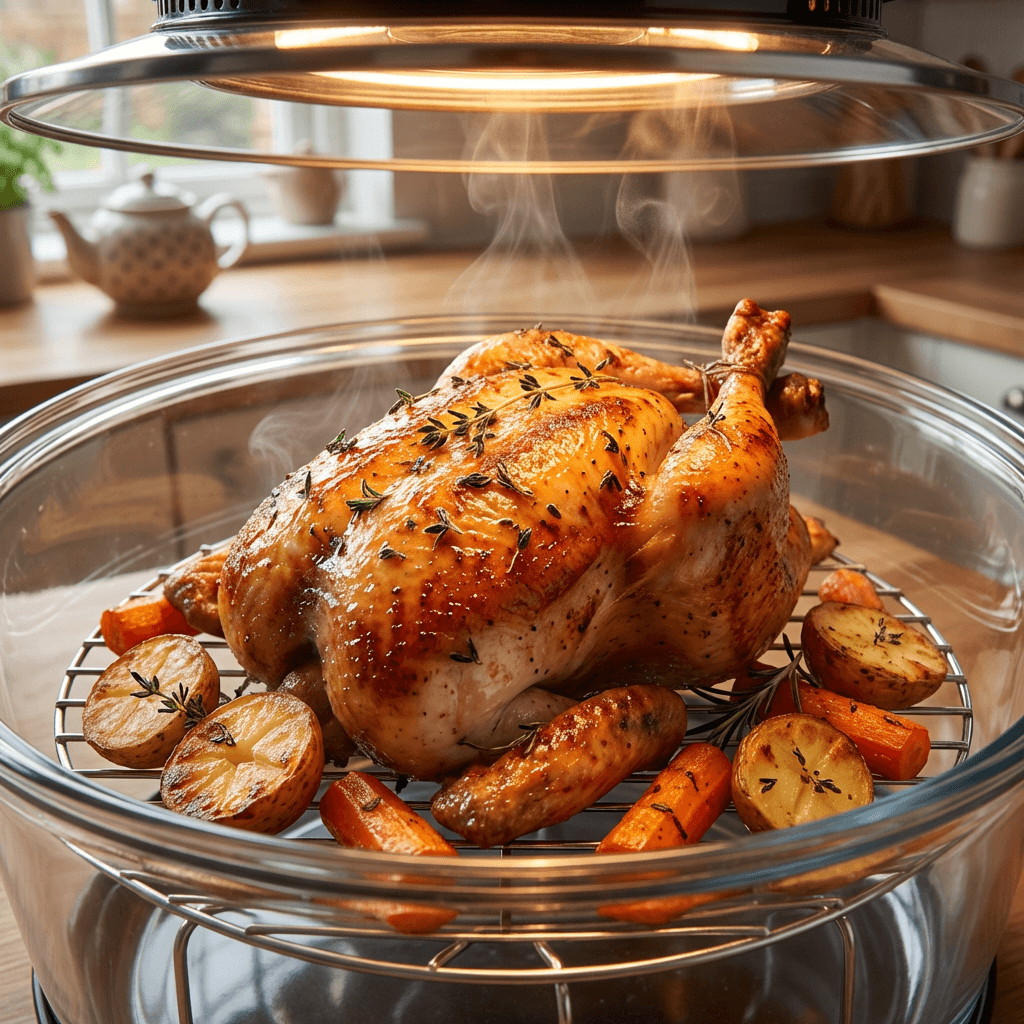
A halogen oven is a countertop cooker with a glass bowl and a heated lid. It cooks food using a halogen heating element plus circulating hot air. In everyday use, it behaves a bit like a compact convection oven.
Most models sold in the UK are around 1400W, with common sizes around 12 to 17 litres. Current UK listings and product pages commonly show halogen ovens at about 1400 watts, including examples from Amazon listings and product descriptions.
That wattage matters because your electricity cost depends on two simple things:
- how powerful the appliance is
- how long you run it
And that brings us to the calculation that matters most.
How do you calculate the running cost?
The basic formula is very simple:
Appliance wattage ÷ 1000 × hours used × electricity unit rate = cost
A kilowatt hour, or kWh, is the amount of energy used by a 1,000-watt appliance running for one hour.
So if your halogen oven is 1400W, that means it uses:
1.4 kWh if it runs flat out for one full hour
Now apply the 2026 UK electricity price cap averages from Ofgem.
At January–March 2026 rates:
1.4 × 27.69p = 38.77p per hour
At April–June 2026 rates:
1.4 × 24.67p = 34.54p per hour
So the headline answer is this:
A typical 1400W halogen oven costs roughly 35p to 39p per hour to run in the UK in 2026 at average Ofgem cap rates.
That is the maximum-style calculation if the unit pulls full power for the entire hour. In real use, some models cycle on and off as they maintain temperature, so actual usage can be a bit lower depending on the meal, temperature, and cooking pattern. That means your real-world cost is often better understood per meal, not just per hour.
What does that mean per meal?
This is where halogen ovens start to look more appealing.
Many everyday meals do not need a full hour.
Here are some rough examples using a 1400W halogen oven and the April–June 2026 average electricity rate of 24.67p/kWh.
15 minutes
1.4 × 0.25 × 24.67p = 8.63p
20 minutes
1.4 × 0.333 × 24.67p = about 11.51p
30 minutes
1.4 × 0.5 × 24.67p = 17.27p
45 minutes
1.4 × 0.75 × 24.67p = about 25.90p
60 minutes
1.4 × 1 × 24.67p = 34.54p
Using the earlier January–March 2026 rate of 27.69p/kWh, those same cooking times come out slightly higher:
- 15 minutes: 9.69p
- 20 minutes: 12.92p
- 30 minutes: 19.38p
- 45 minutes: 29.07p
- 60 minutes: 38.77p
That means a lot of basic meals fall into a very reasonable range.
For example:
- sausages and roast veg: often around 20–35 minutes
- chicken portions and potatoes: often around 30–45 minutes
- fish fillets with vegetables: often around 15–25 minutes
- reheating leftovers with crisping: often around 10–20 minutes
In other words, for many simple meals, you are often looking at something like 10p to 26p per session, depending on the food and the tariff period.
That is not free. But compared with heating a full-size oven for a small dinner, it can be a meaningful saving.
Why can a halogen oven be cheaper than a standard oven?
The biggest reason is not just wattage.
It is wasted space.
A standard electric oven is much larger, so it usually takes more energy to heat the cavity and keep it hot. Energy Saving Trust says electric ovens are generally bigger than other cooking appliances and can be among the most expensive options for individual portions. In its comparison example, cooking a 600g chicken breast cost about £0.21 in Great Britain in an electric oven, while the same portion in an air fryer cost £0.15. The wider point is that small cooking appliances can be more economical for smaller portions because they avoid heating unnecessary space.
A halogen oven sits in a similar “compact cooker” category in practical day-to-day use. It is usually faster to heat than a full-size oven, works in a smaller space, and is often used for modest portions. So even if its rated power is not tiny, the total cooking session can still work out cheaper than using a full built-in oven.
That is why the real question is not:
“Does a halogen oven use electricity?”
Of course it does.
The better question is:
“Does it use less electricity than the alternative for the same meal?”
Often, yes.
Is a halogen oven always cheaper than an air fryer?
Not necessarily.
This is where many articles become too simplistic.
A halogen oven can be cheaper than a standard oven for many meals. But against an air fryer, the picture is less clear.
Energy Saving Trust says air fryers are generally cheaper than ovens for the same meal, especially for one or two people. Other UK consumer coverage has also argued that although halogen ovens can have a lower purchase price, air fryers often win on overall efficiency and convenience for many common foods.
So where does that leave the halogen oven?
A halogen oven still has some strengths:
- lower upfront cost in many cases
- generous bowl capacity for the money
- useful visibility through the glass bowl
- flexible for roasting, baking, reheating, and batch-style tray cooking
- handy for people who do not want a full-size oven on every evening
But if your main goal is the absolute lowest cost for very small portions, a modern air fryer may still come out ahead quite often.
So the smarter claim is this:
A halogen oven is often cheaper than a full-size electric oven, but not always cheaper than a good air fryer for small portions.
That balanced view is much more believable, and much more useful for readers.
Real-life examples: what might you pay for common meals?
Let’s make this practical.
These are reasonable cost illustrations for a 1400W halogen oven, based on the April–June 2026 average rate of 24.67p/kWh. They are estimates, not guarantees, because cooking time varies by portion size, starting temperature, and model.
1) Two chicken thighs with roast potatoes and carrots
Approximate cooking time: 40 minutes
1.4 × 0.667 × 24.67p = about 23.03p
2) Sausages, onion wedges, and peppers
Approximate cooking time: 30 minutes
Cost: about 17.27p
3) Salmon fillet with baby potatoes and broccoli
Approximate cooking time: 25 minutes
1.4 × 0.417 × 24.67p = about 14.40p
4) Reheating leftover roast dinner
Approximate cooking time: 15 minutes
Cost: about 8.63p
5) Baked potatoes for one or two people
Approximate cooking time: 50 minutes
1.4 × 0.833 × 24.67p = about 28.78p
Those are the sorts of numbers that make a halogen oven attractive for budget-minded households. Not because every meal costs pennies, but because many practical meals stay below the cost of using a large conventional oven for the same quantity of food.
Does preheating make a difference?
Yes, and this is one of the small details that changes the real outcome.
A full-size oven often involves a more noticeable preheat period. A halogen oven is usually quicker to get going, which helps reduce wasted energy before the actual cooking starts.
That may sound like a minor point, but over weeks and months it matters. Small habits shape total bills.
If you only cook one tray of food for one person, using a big oven can be a little like heating an entire house to warm one room. Technically it works. Financially it is not always elegant.
When a halogen oven saves the most money
A halogen oven tends to give the best value in these situations:
Small households
If you are cooking for one or two people, it often makes more sense than firing up a full-size oven.
Midweek practical meals
Simple dinners such as sausages, chicken portions, fish, vegetables, or reheated leftovers are where the halogen oven earns its keep.
People avoiding “big oven waste”
If you dislike using a large oven for one tray, a halogen oven solves that problem neatly.
Cooler months when you still want hot food
Many people want roast-style food in autumn and winter but do not want the hassle or cost of using the full oven constantly.
Budget-aware cooking routines
When you build a repeatable set of 20- to 40-minute meals around one appliance, the savings become easier to notice.
When it may not be the cheapest choice
It is also worth being honest about where a halogen oven is less impressive.
Very small portions
For tiny portions, a good air fryer may still be the more efficient option.
Long slow cooking
If you are running the halogen oven for a very long time, the savings versus other methods may shrink.
Big family cooking
If you are feeding several people at once, a standard oven can become more efficient per portion simply because of its capacity.
Bulky or awkward meals
Large casseroles, multiple shelves, or baking jobs may be easier in a conventional oven.
This is important from a trust perspective. Readers are more likely to believe the savings claim when you also tell them where the appliance is not the winner.
What about the standing charge?
For appliance comparisons, most people should focus on the unit rate, not the standing charge.
Why?
Because the standing charge is paid daily whether or not you use the halogen oven. Ofgem explains that the standing charge is a fixed daily cost on your bill, while the unit rate is what you pay per kWh used.
So when comparing a halogen oven with a full-size oven or air fryer, the question is mainly:
How many kWh does each appliance use for the same job?
That is the useful comparison.
So, how much does a halogen oven really cost to run in the UK in 2026?
Here is the plain-English answer.
For a typical 1400W halogen oven, the expected running cost at 2026 Ofgem average electricity rates is roughly:
- 35p to 39p per hour
- around 9p to 19p for 15–30 minutes
- around 23p to 29p for 40–45 minutes
- and often somewhere between 10p and 26p for many everyday meals
That means a halogen oven is not expensive to run in absolute terms, especially if you use it strategically for the kinds of meals it suits best.
It will not transform your finances overnight.
But it can help you avoid one of the most common kitchen money leaks in the UK: using a full-size electric oven for small portions too often.
Is it still worth buying one in 2026?
For many UK households, yes.
A halogen oven still makes sense if you want:
- a lower-cost alternative to using a big oven every day
- a simple countertop cooker for roast-style meals
- something roomy enough for practical home cooking
- a budget-friendly option without the cost of premium air fryer brands
It may be especially useful for:
- over-50s households
- people cooking for one or two
- anyone watching both grocery costs and electricity use
- people who prefer straightforward, visible cooking without too many digital settings
In 2026, the best kitchen appliance is rarely the one with the loudest hype. It is the one that fits the way you actually cook.
And that is exactly why the halogen oven still deserves attention.
Final verdict
A halogen oven is usually cheaper to run than a full-size electric oven for small to medium everyday meals, because it heats a smaller cooking space and is commonly used for shorter, more focused cooking sessions. At 2026 UK electricity rates, a typical 1400W model costs around 35p to 39p per hour, with many meals landing well below that.
So if your question is:
“Does a halogen oven really save money in the UK in 2026?”
The most accurate answer is:
Yes, it often does — especially when it replaces a full-size oven for smaller everyday meals.
Not every time.
Not for every household.
But often enough to matter.