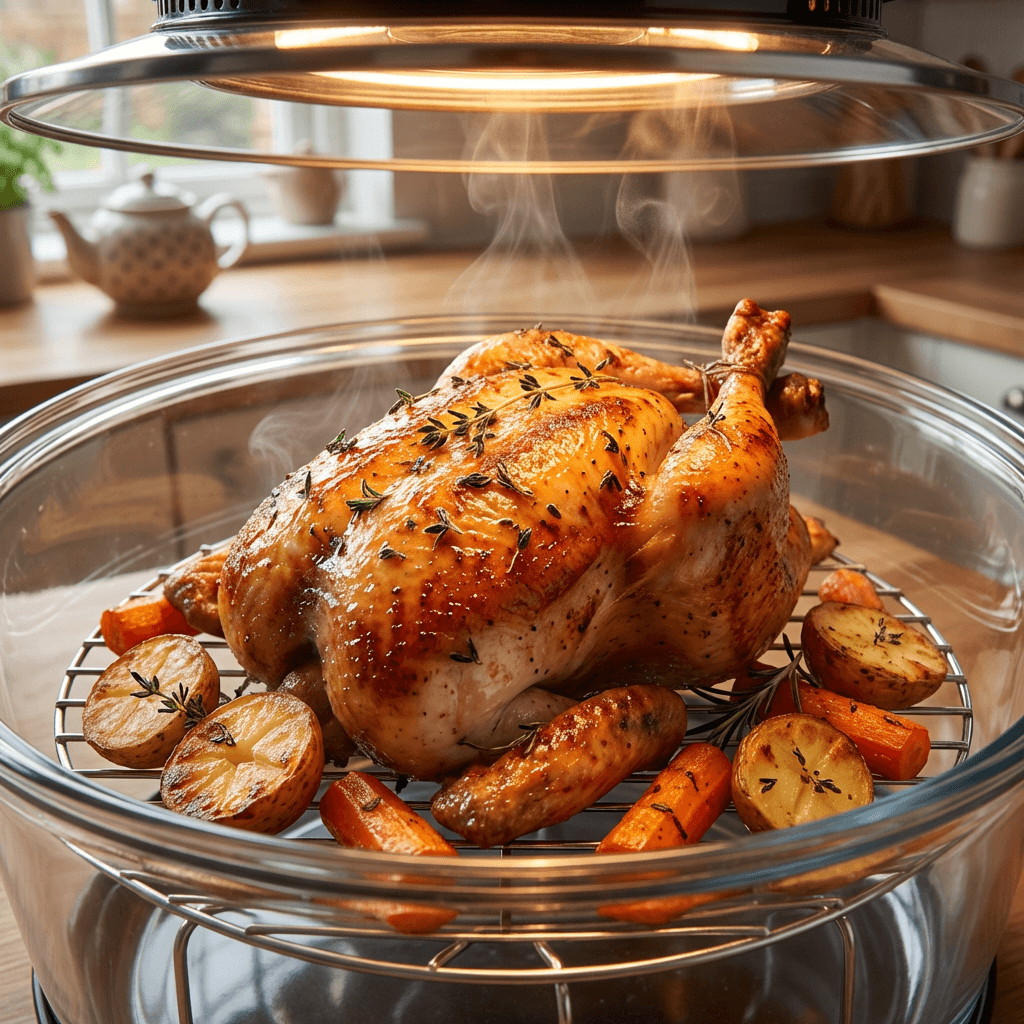

In many British homes, the question is no longer whether a halogen oven still works well. The real question is this: can it replace your main oven, at least for everyday cooking, in 2026?
That is a fair question. Energy costs are still on people’s minds, even after Ofgem’s price cap for a typical direct debit household fell for the period from 1 April to 30 June 2026. Electricity under that cap is 24.67p per kWh, and the broader message for households is still the same: choosing the right appliance for the right job matters. Energy Saving Trust also notes that different cooking appliances suit different tasks, and fan ovens tend to be more efficient than conventional ovens because they circulate hot air more effectively.
That is exactly why halogen ovens keep attracting attention in the UK. They are compact, quick to heat, and often sold in the 12 to 17 litre range, with many popular models around 1300W to 1400W.
But here is the honest answer from the start:
Yes, a halogen oven can replace your main oven for many households some of the time.
No, for most households it will not replace a full-size oven for everything.
And that is not a disappointing answer. In fact, it is the most useful one.
Because if you understand where a halogen oven shines, where it struggles, and what kind of household it suits best, you can make a much smarter decision. For some people, it becomes their weekday workhorse. For others, it is a backup tool, a summer kitchen helper, or a money-saving second cooker. And for a few people, especially singles, couples, or light cooks, it may come surprisingly close to becoming the main oven most days.
Let’s look at what UK households should really know before making that switch.
Why this question matters more in 2026
A few years ago, many people saw halogen ovens as a quirky budget gadget. Something between a tabletop cooker and an old-school TV shopping buy.
Now the conversation is different.
In 2026, British households are thinking more carefully about:
- energy use
- kitchen flexibility
- batch size
- speed and convenience
- whether heating a large oven for a small meal still makes sense
That shift is logical. Even with the latest reduction in the price cap, energy remains a meaningful household expense, and cooking choices can still affect day-to-day bills. Energy Saving Trust’s guidance continues to emphasise using the right appliance for the right amount of food rather than defaulting to the largest appliance every time.
A halogen oven appeals because it feels more proportionate. If you are cooking two chicken thighs, a tray of roast vegetables, a jacket potato, or some sausages for one or two people, switching on a full-size main oven can feel excessive.
That is where halogen ovens make people rethink old habits.
What a halogen oven actually does well
Before deciding whether it can replace a standard oven, we need to understand its strengths.
A halogen oven cooks using a combination of halogen heat, convection, and a compact cooking chamber. In simple terms, it surrounds food with circulating hot air inside a much smaller space than a conventional built-in oven.
That smaller space is one of its biggest advantages.
1. It heats up quickly
A large oven has a lot of empty space to heat. A halogen oven has much less. That makes it feel fast and practical for everyday use.
If you are tired, busy, or cooking late in the evening, speed matters. A halogen oven often feels less like “preparing to cook” and more like simply getting on with dinner.
2. It suits smaller meals
This is where halogen ovens really earn their place.
They work especially well for:
- chicken thighs
- sausages
- fish fillets
- roast potatoes
- small trays of vegetables
- jacket potatoes
- frozen convenience foods
- reheating crispy leftovers
- simple one- or two-person meals
For many midlife households in the UK, that already covers a huge share of weekday cooking.
3. It gives good browning and crispness
Many people like halogen ovens because food can come out nicely browned on the outside. Potatoes crisp well. Skin on chicken can turn golden. Roasted vegetables often get lovely edges.
If your main complaint about some appliances is that food turns soft or pale, a halogen oven can feel more satisfying.
4. It is useful in warmer weather
In summer, a full-size oven can make the kitchen uncomfortably hot. A halogen oven still produces heat, of course, but in many homes it feels less intrusive than running a big oven for a small tray of food.
5. It encourages simpler cooking
This may sound small, but it matters.
A halogen oven often nudges people toward simpler, more manageable meals. Not because it is limiting in a bad way, but because it encourages practical thinking:
- What do I actually need tonight?
- How much food am I really cooking?
- Can I cook this faster and with less fuss?
That can be surprisingly helpful if you are trying to eat more sensibly, waste less, and avoid overcomplicated meal prep.
Where a halogen oven struggles
Now for the other side.
A halogen oven is useful. But it is not magic. And many people become disappointed only because they expect it to behave like a full-size oven in every situation.
That is the wrong expectation.
1. Capacity is the biggest limitation
This is the number one issue.
A halogen oven may be perfectly fine for one or two people, and sometimes manageable for three. But once you are cooking for a larger family, guests, or doing a big Sunday roast with multiple side dishes, it quickly starts to feel restrictive.
Yes, some models have extender rings. Yes, you can fit quite a lot in certain setups. But it is still not the same as having multiple shelves in a full oven.
So if your household regularly cooks:
- large joints of meat
- multiple trays at once
- big bakes
- family-size casseroles
- bulk meal prep
then your main oven still has a very strong role.
2. It is not ideal for everything
Halogen ovens are good at roasting-style cooking. They are less impressive when you need:
- very even baking across large surfaces
- lots of tray space
- delicate multi-stage cooking
- several dishes at the same time
- precise results for ambitious baking
Can you bake in a halogen oven? Yes.
Will it fully replace a proper oven for keen bakers? Usually not.
3. The top heat can be aggressive
One of the classic halogen oven complaints is that food browns too fast on top.
That is not always a design flaw. Sometimes it is a learning curve. Food may need:
- lower rack positioning
- foil protection
- a slightly lower temperature
- turning partway through
- smaller portions
- more attention than in a conventional oven
If you like to “set it and forget it,” you may find a halogen oven slightly less forgiving.
4. Bowl size and shape can be awkward
Some dishes simply do not fit well. Standard baking tins, lasagne dishes, and certain roasting trays may be too large or inconvenient. Over time, some people find this mildly annoying.
Not a disaster. Just a reality.
So, can it replace your main oven?
Here is the honest, practical answer.
A halogen oven can replace your main oven if…
It can come close to replacing it for everyday use when:
- you live alone or as a couple
- you mostly cook simple meals
- you roast, reheat, grill, or bake small portions
- you do not often entertain
- you are not regularly batch cooking
- your kitchen space is limited
- you want a second cooker to reduce dependence on a large oven
For this kind of household, a halogen oven may become the appliance you use most often Monday to Friday.
In other words, it may not replace the main oven in theory, but in practice it may replace it for most ordinary meals.
That is an important distinction.
It probably will not replace your main oven if…
A halogen oven is less likely to replace your standard oven if:
- you cook for four or more people most days
- you bake often
- you prepare multiple oven dishes together
- you do batch cooking every week
- you rely on large casserole dishes or roasting tins
- you want maximum convenience and minimal monitoring
In these homes, the halogen oven is usually a supporting appliance, not the star.
And that is perfectly fine too.
The real value is not “replacement” but “reduction”
This is where people often think about it the wrong way.
The best question may not be:
“Can it replace my oven completely?”
The better question is:
“How often can it stop me from needing my main oven?”
That is where the value often appears.
If your halogen oven handles:
- 4 weekday dinners a week
- reheating leftovers
- quick lunches
- jacket potatoes
- small roast trays
- frozen fish or chicken portions
- roasted veg sides
then it may significantly reduce how often you use your main oven, even if it never fully replaces it.
And for many UK households, that is already a very worthwhile win.
What kinds of UK households benefit most?
Let’s make this practical.
Best fit: singles and couples
If there are one or two of you in the house, a halogen oven makes a lot of sense.
This is especially true if:
- children have moved out
- appetite and portion sizes are smaller than before
- you no longer cook large family meals every night
- you want fast meals without heating a big oven
For empty nesters, retirees, or midlife couples, this can be one of the strongest use cases.
Good fit: budget-conscious households
People trying to manage bills carefully often become more intentional about appliance use. Since cooking appliance choice affects energy use, using a smaller cooker for smaller meals can be a sensible household habit.
The point is not to chase miracle savings claims. The point is to avoid wasting energy heating a large cavity when a smaller cooking space would do the job.
That is a practical mindset, not a gimmick.
Good fit: people with limited mobility or energy
For some households, the issue is not only money. It is effort.
A countertop cooker that feels easier to access than bending to a low built-in oven may be genuinely useful. That said, the glass bowl and lid can still be awkward or heavy for some users, so suitability depends on the individual.
Mixed fit: families
Families can still benefit from a halogen oven, but usually as a helper appliance.
For example:
- nuggets, wedges, or quick lunches for children
- extra side dishes
- reheating leftovers
- cooking a smaller second meal
- reducing competition for the main oven
That is useful, but it is not full replacement territory for most family homes.
What foods work best in a halogen oven?
If you want a halogen oven to feel worthwhile, use it for the foods that suit it naturally.
These tend to include:
Excellent choices
- chicken thighs and drumsticks
- sausages
- burgers
- salmon fillets
- white fish
- roast potatoes
- chips and wedges
- peppers, onions, carrots, courgettes
- jacket potatoes
- garlic bread
- reheated pizza slices
- frozen oven foods in smaller amounts
Reasonable choices
- small traybakes
- simple scones
- muffins
- toasted sandwiches
- small gratins
- stuffed vegetables
Less ideal choices
- large cakes
- full family lasagnes
- multiple trays of baking
- very large roasts
- anything needing wide, flat, even baking space
If you stay in the first category most of the time, you are far more likely to love using it.
What people often get wrong
A lot of disappointment comes from using the appliance badly, not from the appliance being useless.
Here are some common mistakes.
1. Overfilling it
Air needs to circulate. If the bowl is too crowded, results suffer.
2. Treating it exactly like a full oven
Cooking times and temperatures often need adjusting. A halogen oven is faster and more intense in a smaller space.
3. Ignoring food height
Because the heat comes strongly from above, tall food can brown too quickly before the middle is ready.
4. Using it for the wrong job
A halogen oven is not the best answer to every cooking problem. Sometimes a microwave, slow cooker, or full oven is the better tool. That matches the broader energy-saving advice: use the right appliance for the task rather than defaulting blindly.
Halogen oven vs main oven: the mindset shift
A main oven is about capacity, flexibility, and doing more at once.
A halogen oven is about efficiency, speed, and proportion.
When people compare them as if they should be identical, the comparison becomes unfair.
A better way to think about it is this:
- your main oven is your high-capacity kitchen workhorse
- your halogen oven is your smart everyday short-cut
If you expect the halogen oven to be a one-to-one replacement for Christmas dinner, it will disappoint you.
If you expect it to take over a large chunk of routine weekday cooking, it may impress you.
Is it still worth buying in Britain in 2026?
For many households, yes.
Not because it is fashionable. Not because it is perfect. But because it still solves a real problem.
It helps answer a very ordinary but important question:
Why heat a big oven for a small meal if you do not need to?
That question is still relevant in Britain in 2026.
Especially for:
- couples
- older households
- frugal cooks
- people with smaller kitchens
- anyone trying to cook more simply
- anyone who wants a practical backup to the main oven
And because many current halogen oven models remain compact and relatively modest in power draw compared with a full-size cooker setup, they continue to appeal to people who value “good enough, faster” over “bigger and more traditional.”
The final verdict
So, can a halogen oven replace your main oven in 2026?
Sometimes, yes. Completely, usually no.
But that answer is more positive than it sounds.
For the right household, a halogen oven can replace the main oven for a big share of everyday meals. It can make weeknight cooking faster, simpler, and more proportionate to the amount of food you actually eat.
For other households, it works best as a second cooker that saves time, frees up the main oven, and handles smaller jobs beautifully.
That is really the key point.
You do not have to choose between “full replacement” and “not worth having.” There is a middle ground, and for many UK homes, that middle ground is where the halogen oven proves its value.
If you cook mostly for one or two people, want less fuss, and like the idea of roasting, crisping, and reheating without firing up a large oven every time, then yes, a halogen oven may be one of the most practical kitchen helpers you can still buy in 2026.
Not a miracle.
Not a gimmick.
Just a very useful appliance — when matched to the right household.