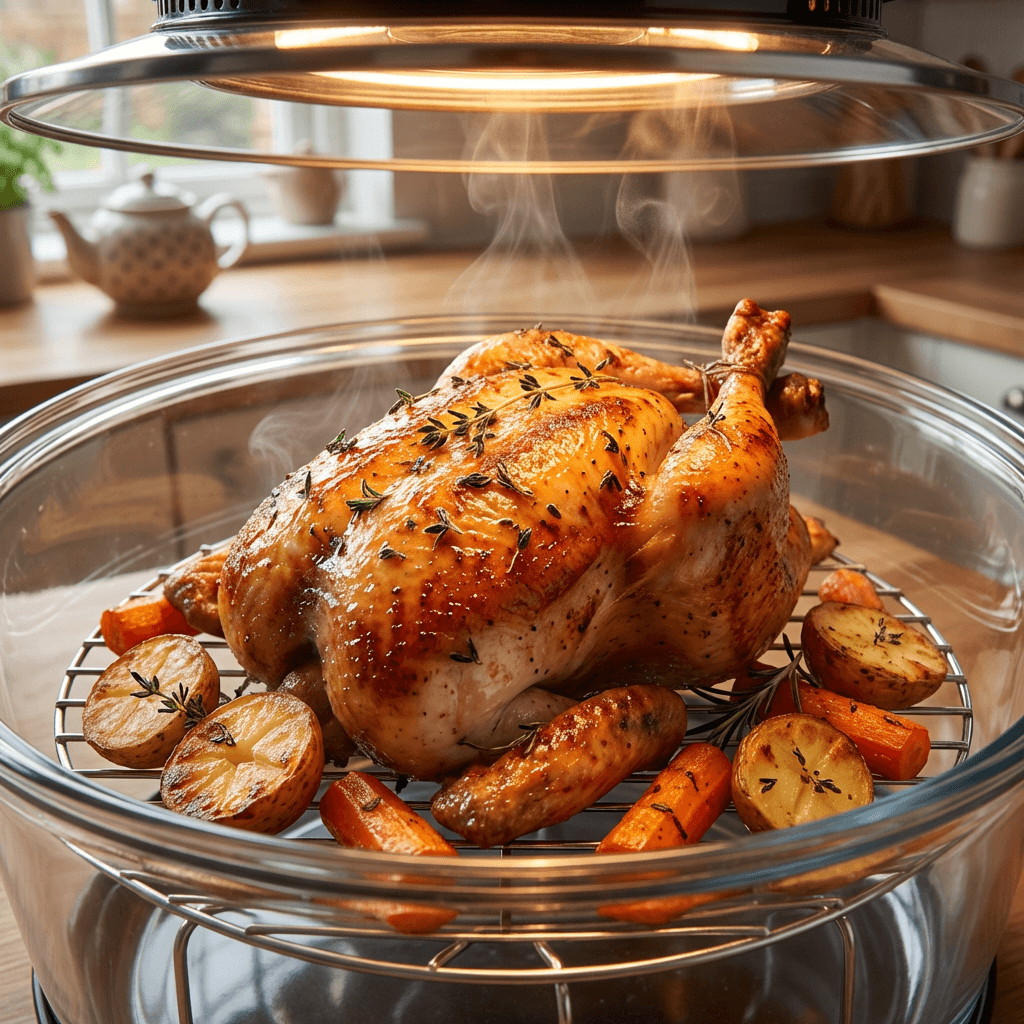
With electricity prices still putting pressure on household budgets, many people are taking a closer look at the appliances they use every day.
A full-sized electric oven can feel excessive when you are cooking a baked potato, two portions of chicken, a small fish fillet or a tray of vegetables. This is one reason compact appliances such as halogen ovens remain popular, especially among smaller households, couples and people cooking for one.
But how much does a halogen oven really cost to run in the UK in 2026?
For a typical halogen oven rated between 1,200 and 1,400 watts, the estimated electricity cost is approximately:
- 16p to 18p for 30 minutes
- 23p to 27p for 45 minutes
- 31p to 37p for one hour
These figures are based on an electricity rate of 26.11p per kilowatt-hour, the average Direct Debit price-cap rate applying across England, Scotland and Wales from 1 July to 30 September 2026. Your personal tariff may be higher or lower.
The important question, however, is not simply how much electricity the appliance uses per hour.
The real question is whether a halogen oven can cook the food you need in less time, with little or no preheating, and without heating the much larger cavity of a conventional oven.
Let us look at the numbers properly.
The Quick Answer
A typical 1,300-watt halogen oven costs around:
- 8p for 15 minutes
- 17p for 30 minutes
- 25p for 45 minutes
- 34p for 60 minutes
If you use it for 30 minutes every day, the theoretical cost would be approximately:
- £1.19 per week
- £5.09 per 30-day month
- £61.95 per year
This is a simple maximum-power calculation. In normal cooking, the heating element may switch on and off after the oven reaches the selected temperature, so the real energy use can sometimes be lower.
However, it is sensible to use the full rated power when estimating costs. This gives you a cautious figure rather than an unrealistic promise.
What Electricity Price Are We Using?
From 1 July to 30 September 2026, Ofgem’s average electricity unit rate for a household paying by Direct Debit on a standard variable tariff is 26.11p per kWh.
The average electricity standing charge is 57.19p per day.
The standing charge is not included in the halogen oven calculations in this article.
That is because you pay the standing charge for having an electricity supply, regardless of whether you use a halogen oven, a microwave, a kettle or no cooking appliance at all. Ofgem describes it as a daily charge that is separate from the amount you pay for each unit of energy.
When comparing cooking appliances, the most useful figure is therefore the unit rate per kWh.
It is also important to remember that the Ofgem figure is an average. Electricity rates differ according to:
- your supplier;
- your tariff;
- your region;
- your payment method;
- whether you have a fixed or variable deal;
- whether you use an Economy 7 or time-of-use tariff.
To calculate your exact cost, check the unit rate shown on your latest electricity bill.
How Powerful Is a Halogen Oven?
Many standard glass-bowl halogen ovens use approximately 1,200 to 1,400 watts.
For example, one published halogen oven instruction manual lists a power range of 1,200–1,400W for an 11-litre appliance.
You may also find models rated at:
- 1,200W;
- 1,300W;
- 1,400W;
- occasionally 1,500W or more.
The wattage should be printed on the rating label, usually underneath the appliance, on the lid assembly or in the instruction manual.
A higher wattage does not automatically mean that an appliance will cost dramatically more to use.
A more powerful appliance may reach the required temperature faster. Cooking time, capacity, food quantity, temperature and thermostat behaviour all influence the final energy consumption.
How to Calculate the Running Cost
The calculation is straightforward:
Power in kilowatts × cooking time in hours × electricity price per kWh
For example, imagine that you have a 1,300W halogen oven.
First, convert watts into kilowatts:
1,300W ÷ 1,000 = 1.3kW
If it runs for 30 minutes, convert the time into hours:
30 minutes = 0.5 hours
Then multiply:
1.3kW × 0.5 hours × £0.2611 = £0.1697
Rounded to the nearest penny, the estimated cost is:
17p for 30 minutes
This assumes the appliance draws its full rated power continuously throughout the cooking period. In practice, the thermostat may cycle the heating element on and off.
Halogen Oven Running-Cost Table for 2026
The table below uses the July–September 2026 average electricity rate of 26.11p per kWh.
| Cooking time | 1,200W oven | 1,300W oven | 1,400W oven |
|---|---|---|---|
| 15 minutes | 8p | 8p | 9p |
| 20 minutes | 10p | 11p | 12p |
| 30 minutes | 16p | 17p | 18p |
| 40 minutes | 21p | 23p | 24p |
| 45 minutes | 23p | 25p | 27p |
| 60 minutes | 31p | 34p | 37p |
These are estimated upper-end figures based on continuous operation at full stated wattage.
Your actual electricity consumption may be lower if the thermostat reduces power after the oven reaches the selected temperature.
What Does It Cost per Week, Month and Year?
Let us use a typical 1,300W halogen oven as an example.
Using it for 30 minutes three times a week
One 30-minute session costs approximately 17p.
That works out at around:
- 51p per week
- £2.21 per average month
- £26.48 per year
Using it for 30 minutes five times a week
The estimated cost is:
- 85p per week
- £3.68 per average month
- £44.13 per year
Using it for 30 minutes every day
The estimated cost is:
- £1.19 per week
- £5.09 per 30-day month
- £61.95 per year
Using it for 45 minutes every day
At full power, a 45-minute session costs approximately 25p.
That would equal roughly:
- £1.78 per week
- £7.64 per 30-day month
- £92.92 per year
These figures show why cooking time matters just as much as wattage.
An appliance that uses 1,300W for 25 minutes may use less electricity than a lower-powered appliance that must run for 50 minutes.
Does a Halogen Oven Need Preheating?
One of the practical advantages of many halogen ovens is that they heat up very quickly.
A conventional oven may require 10 to 15 minutes of preheating before the food is placed inside. A halogen oven’s heating element and fan begin directing heat around a much smaller cooking space almost immediately.
Some recipes may still benefit from a few minutes of preheating, particularly when you want crisp pastry, chips or a strongly browned surface.
For many everyday meals, however, extensive preheating is unnecessary.
This matters because preheating is not free.
For example, running a 1,300W appliance at full power for 10 minutes costs approximately 6p. The saving from avoiding preheating may seem small for one meal, but it becomes more noticeable when repeated several times each week.
The time saving can also make cooking feel easier, especially when you are preparing a simple meal for one or two people.
Is a Halogen Oven Cheaper Than a Conventional Electric Oven?
It can be, particularly for smaller meals.
However, the answer depends on several factors:
- the wattage of your conventional oven;
- how long it takes to preheat;
- how well insulated it is;
- how much food you are cooking;
- whether you use one or several shelves;
- how long each appliance takes to cook the same meal.
A conventional electric oven may be rated at 2,000W, 2,500W, 3,000W or more, although it does not necessarily draw maximum power continuously.
The bigger difference is often the size of the cooking chamber.
A full-sized oven must heat a much larger internal space. When you are cooking only one baked potato, a small portion of fish or a few sausages, heating the whole oven may be inefficient.
A halogen oven usually makes the most financial sense when:
- you are cooking for one or two people;
- the food fits comfortably in the glass bowl;
- you would otherwise use a full-sized electric oven;
- the halogen oven cooks the meal faster;
- little or no preheating is required.
A conventional oven may become more practical when:
- you are cooking several dishes at once;
- you need multiple shelves;
- you are batch-cooking large quantities;
- you are preparing food for a family or several guests;
- the food does not fit safely inside the halogen oven.
The cheapest appliance is the one that completes the entire cooking job efficiently.
Using a halogen oven for half the meal and then switching on the main oven for the rest may remove much of the potential saving.
Halogen Oven Versus Air Fryer
Halogen ovens and air fryers both use concentrated heat and circulating air, but they are not identical.
A typical air fryer may be rated between approximately 1,200W and 2,000W, depending on its size and design. A halogen oven commonly uses around 1,200–1,400W.
This does not mean that every halogen oven is automatically cheaper.
An air fryer may cook certain foods faster. A halogen oven may offer a larger, wider bowl that is useful for baked dishes, vegetables, fish, chicken or several portions arranged on racks.
When comparing the two, consider:
- the rated wattage;
- usable cooking capacity;
- actual cooking time;
- whether preheating is needed;
- how much food fits in one batch;
- how easy the appliance is for you to load and clean.
Two batches in a small air fryer may cost more than one complete batch in a larger halogen oven.
Equally, running a large halogen oven for 45 minutes to prepare a very small snack may be less efficient than using a compact air fryer for 12 minutes.
Halogen Oven Versus Microwave
For reheating food, warming soup, cooking porridge or heating vegetables, a microwave will often be the cheaper option because it can complete the task very quickly.
A microwave does not normally provide the same roasted or browned finish as a halogen oven.
The two appliances are better viewed as complementary tools.
Use a microwave when you mainly need to heat food quickly.
Use a halogen oven when you want to:
- roast;
- bake;
- brown;
- crisp;
- grill;
- cook food on a rack;
- prepare a small oven-style meal.
You can also combine them.
For example, you might partly cook a large potato in the microwave and finish it in the halogen oven to crisp the skin. This can reduce the total halogen cooking time.
Which Meals Are Most Economical in a Halogen Oven?
A halogen oven is particularly useful for meals that would normally require a conventional oven but do not fill it.
Good examples include:
Baked potatoes
A baked potato can be cooked alone or alongside vegetables. Starting it in the microwave may reduce the total cooking time.
Fish fillets
Small fish fillets often cook quickly and do not justify heating a large oven.
Chicken portions
Chicken thighs, drumsticks or a small chicken can work well, provided you follow safe cooking guidance and check that the thickest part is fully cooked.
Sausages and vegetables
These can often be cooked together on a tray or rack, reducing the need to operate more than one appliance.
Frozen chips or potato wedges
A halogen oven can produce a crisp result without heating a full-sized oven.
Small baked dishes
A small pasta bake, vegetable gratin or egg-based dish may fit comfortably in an ovenproof container placed inside the bowl.
Roasted vegetables
Carrots, peppers, courgettes, onions, potatoes and similar vegetables can be prepared in small portions without warming a large kitchen.
How to Reduce Halogen Oven Running Costs
You do not need to chase every fraction of a penny. A few practical habits can make a more meaningful difference.
1. Avoid unnecessary preheating
Only preheat when the recipe or desired texture genuinely requires it.
2. Cook more than one item at a time
Use the available space efficiently without overcrowding the oven or blocking airflow.
For example, cook fish on one rack and suitable vegetables below, provided this is safe and appropriate for the recipe.
3. Cut food into evenly sized pieces
Smaller, evenly sized portions usually cook more quickly and consistently.
4. Do not repeatedly lift the lid
Every time the lid is lifted, heat escapes and the appliance must restore the cooking temperature.
Use the transparent glass bowl to check the food where possible.
5. Use the correct temperature
A higher temperature does not always make food cook better or significantly faster. It may brown the outside before the centre is ready.
6. Defrost food safely before cooking
Cooking suitable food from a safely defrosted state can reduce cooking time. Always follow the food manufacturer’s instructions and normal food-safety guidance.
7. Combine appliances intelligently
A microwave can soften dense food such as potatoes before the halogen oven finishes the surface.
8. Keep the bowl and racks clean
Heavy grease and burnt residue can interfere with airflow and make the appliance less pleasant to use.
9. Choose appropriately sized cookware
A very thick or oversized dish may slow heat transfer. Use oven-safe cookware that allows hot air to circulate.
10. Switch the appliance off as soon as the food is ready
Do not leave it running simply to keep a small meal warm for an extended period.
Does the Thermostat Reduce the Real Cost?
A halogen oven does not necessarily consume its full rated wattage every second.
When the selected temperature is reached, the thermostat may switch the heating element off temporarily. The fan or other components may continue operating, and the element switches back on when more heat is required.
This is why a plug-in energy monitor can be useful.
Instead of relying only on the label wattage, an energy monitor can show how many kilowatt-hours the appliance uses during a real cooking session.
For example, you could measure:
- one baked potato;
- two chicken portions;
- a tray of vegetables;
- a small frozen pizza;
- a typical 30-minute dinner.
Multiply the measured kWh by the unit price on your electricity bill.
This gives you a personalised figure based on your appliance, your recipes and your tariff.
Are Halogen Ovens Worth It for People Over 50?
For many people over 50, the value of a halogen oven is not limited to electricity costs.
A countertop oven can be useful because:
- food is visible through the glass bowl;
- the appliance has simple time and temperature controls;
- it can reduce the need to bend down to a low oven;
- it heats quickly;
- it works well for smaller portions;
- it may produce less heat in the kitchen;
- removable parts can often be taken to the sink for cleaning.
Accessibility varies between models.
Traditional halogen ovens often have a heavy lid. The glass bowl may also be awkward to lift and clean. People with limited hand strength, reduced coordination or mobility difficulties should consider these points before buying.
A hinged-lid design may be easier for some users because the hot lid remains attached to the appliance.
The oven should be positioned on a stable, heat-resistant worktop with enough space around it. The controls, lid and food should be reachable without unsafe stretching.
Saving a few pounds is not worthwhile if the appliance is uncomfortable or unsafe for you to operate.
What About the Purchase Price?
Running cost is only one part of the decision.
A halogen oven must first save enough electricity, time or effort to justify its purchase price.
Suppose a new appliance costs £50 and saves an average of 20p every time you cook compared with your usual method.
You would need to use it approximately:
£50 ÷ £0.20 = 250 times
If you use it five times a week, that is about one year of regular use.
This example is deliberately simple. The real saving may be smaller or larger, and convenience may be just as important as electricity.
It usually makes little sense to replace a reliable appliance purely because a new model claims to be more efficient.
However, if you already need a compact oven, regularly cook small portions or avoid using your main oven because it is inconvenient, a halogen oven may offer practical value.
Common Running-Cost Mistakes
Confusing watts with kilowatt-hours
Watts describe power. Your electricity bill charges you for energy used over time, measured in kilowatt-hours.
Adding the standing charge to every meal
The standing charge is paid daily regardless of which cooking appliance you use. It should not normally be assigned to one halogen-oven meal.
Assuming the appliance always draws maximum power
Label wattage gives a useful cautious estimate, but thermostat cycling may reduce actual consumption.
Comparing appliances by wattage alone
Cooking time and batch size are equally important.
Ignoring preheating
A main oven that takes 15 minutes to preheat is already consuming energy before cooking begins.
Believing every efficiency claim
Marketing claims may use different foods, temperatures, appliances and testing methods. Your own plug-in energy monitor provides more relevant information.
How Much Would Your Halogen Oven Cost?
Use this simple formula:
Wattage ÷ 1,000 × hours used × electricity rate
For example, if your halogen oven is rated at 1,400W, you use it for 35 minutes, and your electricity costs 28p per kWh:
- Convert the power:
1,400W ÷ 1,000 = 1.4kW - Convert the time:
35 ÷ 60 = 0.583 hours - Multiply:
1.4 × 0.583 × £0.28 = approximately £0.23
Your estimated cost would be about 23p.
Frequently Asked Questions
How much does a halogen oven cost to run for 30 minutes?
At the July–September 2026 average electricity rate of 26.11p per kWh, a 1,200–1,400W halogen oven costs approximately 16p to 18p for 30 minutes at full rated power.
How much does it cost to run for one hour?
Approximately 31p to 37p, depending on wattage.
A typical 1,300W model costs about 34p per hour at full power.
Is a halogen oven cheaper than an electric oven?
It is often cheaper for small meals because it heats a smaller space, may require little preheating and can cook food more quickly.
It may not be cheaper when a large conventional oven is fully loaded with several dishes.
Is a halogen oven cheaper than an air fryer?
Neither appliance is automatically cheaper in every situation.
Compare wattage, cooking time and the number of batches required.
Does a halogen oven use electricity continuously?
The appliance may draw maximum power while heating, but the thermostat can cycle the element on and off after the selected temperature is reached.
Can I check the real cost myself?
Yes. Use a suitable plug-in electricity monitor and record the number of kilowatt-hours consumed during a normal cooking session.
Multiply that figure by your electricity unit rate.
Final Verdict
At the UK electricity price used in this article, a typical halogen oven costs approximately 17p for 30 minutes or 34p for one hour.
For a person cooking one or two portions, it can be an economical alternative to heating a full-sized electric oven.
Its strongest advantages are:
- a smaller cooking space;
- fast heat-up;
- little or no preheating for many meals;
- good visibility;
- suitability for everyday portions;
- the ability to roast, bake, grill and brown food.
It is not automatically the cheapest appliance for every task.
A microwave will usually remain more economical for simple reheating. A full-sized oven may be more efficient when it is completely loaded. An air fryer may cook some foods faster.
The best way to save money is to match the appliance to the meal.
For small oven-style meals, a halogen oven can be a practical and reasonably inexpensive choice — and in many UK households, that may matter just as much as the headline cost per hour.
Cost estimates are illustrative and are based on the average Ofgem electricity unit rate applying from 1 July to 30 September 2026. Check your own electricity bill and appliance rating label for a personalised calculation.