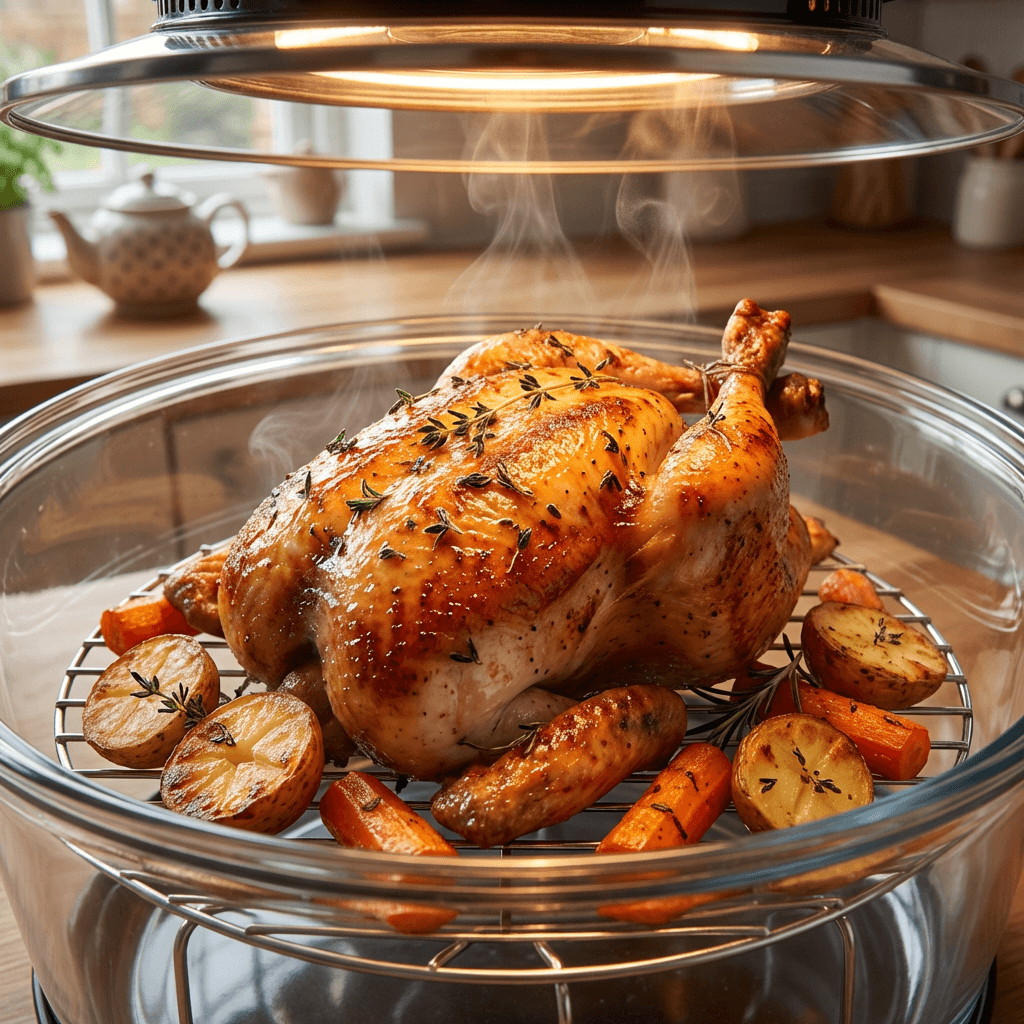
Some links in this article may be affiliate links. If you buy through one of them, we may earn a small commission at no extra cost to you. We only discuss accessories that may offer a genuine practical benefit.
Halogen oven accessories look inexpensive one at a time, yet several unnecessary extras can cost as much as choosing a better-equipped oven in the first place.
For most people, the best accessories are not large boxed sets. They are a few well-chosen items that make hot food easier to lift, improve airflow or reduce washing-up.
This guide looks closely at tongs, racks and bowls, with practical advice for UK households and cooks over 50. The aim is not to fill a cupboard with gadgets. It is to help you buy less, use more and handle your halogen oven with greater confidence.
Quick Verdict: What Is Worth Buying?
| Accessory | Usually worth it? | Best for | Main warning |
|---|---|---|---|
| Rack-lifting tongs | Yes, if the supplied pair is poor | Removing hot racks and shallow trays | Must grip your exact rack securely |
| Long food tongs | Often | Turning food without reaching into the bowl | Not designed to lift a loaded rack |
| Spare low rack | Sometimes | Replacing a bent, rusty or lost rack | Check diameter, leg height and stability |
| Spare high rack | Sometimes | Browning food closer to the heat | Food may brown before the centre is cooked |
| Two-level rack setup | Useful for some meals | Cooking smaller items at the same time | Do not block hot-air circulation |
| Small oven-safe cooking dish | Often | Saucy foods, bakes, eggs and easier cleaning | Leave space around it for airflow |
| Replacement main glass bowl | Only when needed | Replacing a damaged compatible bowl | Heavy, model-specific and awkward to store |
| Large accessory bundle | Rarely | Only if several included parts are genuinely needed | Often duplicates items supplied with the oven |
If your oven already came with sturdy lifting tongs, a stable low rack and a high rack, use those first. After several meals, you will know what is genuinely missing.
Start by Checking What You Already Own
Traditional glass-bowl halogen ovens are commonly supplied with at least one cooking rack, and many include both high and low racks.
Larger models may also arrive with rack-lifting tongs, a lid stand and an extender ring. This means an attractive accessory set may contain several things already sitting in your cupboard.
Before buying anything, place all your existing parts on the worktop and ask four questions:
- Which item solves a problem I have experienced? A useful accessory should make a regular task safer, easier or less messy.
- Does it fit my exact oven? Capacity labels such as 12L or 17L do not guarantee identical bowl diameters or rack heights.
- Can I hold and clean it comfortably? A bargain is not useful if the handles are fiddly, the metal flexes or the item is too heavy.
- Where will I store it? Bulky spare bowls and duplicate racks can quickly become clutter.
If you are still building your basic setup, read our related guide: 10 Halogen Oven Accessories You’ll Actually Use in a British Kitchen.
It covers a wider range of practical extras, including a lid stand, thermometer and extender ring. This guide goes deeper into the three items people are most likely to lift, replace or accidentally buy twice.
Halogen Oven Tongs: One Name, Two Different Jobs
Search for halogen oven tongs and you will find two very different tools. Confusing them can be inconvenient and potentially unsafe.
1. Rack-Lifting Tongs
Rack-lifting tongs are designed to hook around or underneath the wire frame of a cooking rack. They allow you to raise the rack without putting your hands into the hot glass bowl.
These are not ordinary serving tongs. Their shape matters more than their appearance.
A good pair should engage securely with the rack, remain reasonably rigid under load and give you enough control to keep the rack level.
When Rack-Lifting Tongs Are Worth Buying
Replacement rack tongs can be an excellent purchase when:
- the original pair is missing, flimsy or uncomfortable;
- the hooked ends repeatedly slip off the rack;
- reduced hand strength makes the original design difficult to control.
For an older cook, the “best” pair is not necessarily the cheapest or the longest.
Look for broad handles, a stable action and a shape that matches the rack you actually use. If possible, test an unloaded rack before trusting the tongs with hot food.
When Rack-Lifting Tongs Are a Money Waster
Do not buy another pair simply because it is labelled “heavy-duty”. If your current tongs grip securely and feel comfortable, a replacement will add little.
Also avoid buying a generic pair solely on the strength of the word “universal”. The hooks may be too wide, too narrow or positioned incorrectly for your rack.
Most importantly, do not exceed what the tool can control.
A rack carrying a heavy casserole dish, hot liquid or an uneven roast may tilt when lifted. In that situation, it is often safer to remove the food container separately with suitable oven gloves once the appliance has been switched off, unplugged where directed by the manual and allowed to settle.
Verdict: A useful safety upgrade when the original pair is missing, flimsy or uncomfortable. Otherwise, keep the money.
2. Long Kitchen Tongs for Turning Food
Long food tongs do a different job. They help turn sausages, vegetables, fish or potato wedges without bringing your fingers close to the heating unit or the inner wall of the bowl.
A pair around 23–30 cm long will suit many people, but comfort matters more than an exact number.
Look for:
- a non-slip handle;
- moderate spring pressure;
- tips that meet evenly;
- a simple locking mechanism;
- a heat rating suitable for the temperatures you use.
Silicone-tipped food tongs can grip delicate items and protect coated bakeware. Stainless-steel tips may feel firmer but can scratch non-stick surfaces.
Check the manufacturer’s temperature limit for any silicone or plastic parts rather than assuming every pair is suitable for the highest setting on your oven.
Long kitchen tongs are good for food, but they are not a substitute for rack lifters. Trying to lift a loaded wire rack with ordinary food tongs can leave it poorly supported.
Verdict: Often worthwhile, especially if reaching into a deep bowl feels awkward. Buy them for turning food, not for lifting racks.
Halogen Oven Racks: Do You Need More Than Two?
The rack is central to how a traditional halogen oven cooks.
It raises food above the bottom of the glass bowl so hot air can travel around it. Rack height also changes how close the food sits to the heating element.
The Low Rack: The Everyday Workhorse
If you use only one rack regularly, it will probably be the low one.
It is generally the sensible choice for larger or thicker foods that need time to cook through without sitting too close to the heat above.
A low rack is useful for:
- baked potatoes;
- roasting vegetables;
- larger pieces of fish;
- a small roasting tin or oven-safe dish;
- foods that brown too quickly on the high rack.
Because it creates space underneath the food, the low rack can also improve air movement compared with placing a full dish directly on the bottom of the main bowl.
A spare low rack is worth considering only if your existing one is bent, unstable, badly corroded or genuinely inconvenient to clean between different parts of a meal.
Owning two identical low racks rarely transforms everyday cooking.
Verdict: Essential to own, but rarely necessary to duplicate.
The High Rack: Useful for Browning, Not Every Meal
The high rack moves food closer to the heating element.
This can be helpful for toast, open sandwiches, smaller pieces of food and final browning. It may also shorten the distance between the heat source and food that cooks quickly.
That same advantage creates the main risk: the top can darken while the middle still needs more time.
Watch food carefully, particularly when adapting timings from a conventional oven. If the surface is colouring too fast, use the low rack or reduce the temperature as appropriate for the recipe and your appliance.
Verdict: Useful as part of the original pair, but a duplicate is usually unnecessary.
Cooking on Two Levels
Using high and low racks together can help with small foods that need similar temperatures and reasonably similar cooking times.
It can be convenient for a modest meal for two—for example, vegetables on one level and another suitable item on the other.
However, two-level cooking is not simply a way to double the stated capacity.
The upper tray or food can interrupt airflow and shade the lower level from direct heat. You may need to swap positions, turn food or remove one item earlier.
For better results:
- leave gaps between pieces of food;
- avoid covering an entire rack with foil;
- use shallow containers rather than deep dishes;
- check both levels separately;
- never stack racks in a way that feels unstable.
If the rack feet do not sit securely, do not improvise with loose metal supports.
A slightly smaller cooking area is better than a hot, unstable tower inside a glass bowl.
Verdict: A useful technique with the racks you already have. It is not a strong reason to buy a large multi-rack kit.
Bowls and Dishes: Which Type Do You Mean?
“Halogen oven bowl” can refer either to the large structural glass bowl that forms the oven chamber or to a smaller dish placed inside it.
They are not interchangeable purchases.
The Main Glass Bowl: Replace Only When Necessary
The large transparent bowl is one of the pleasures of a halogen oven because you can check progress without repeatedly lifting the lid.
It is also heavy, bulky and essential to the safe fit of the appliance.
A replacement main bowl makes sense when the original is damaged and an exact compatible spare is available.
Before buying, verify:
- the model number;
- external diameter and height;
- capacity;
- the shape of the rim where the lid or extender ring sits;
- the way the bowl rests in its base;
- whether the seller or manufacturer explicitly lists your model.
Do not continue using a bowl that is cracked, chipped around the rim or otherwise damaged.
Do not assume that a bowl with the same advertised litre capacity will fit correctly. Even a small difference at the rim or base may affect stability and the seal under the lid.
Buying a spare main bowl “just in case” is rarely the best use of money.
It is bulky and may still be the wrong part by the time you need it. Keeping an exact spare for an older oven used every day can be reasonable, but that is a specific need.
Handle Glass with Patience
Always follow the care instructions for your model.
As a general safety rule, allow the bowl to cool fully before cleaning and never introduce cold water to hot glass.
Avoid knocks against taps, worktop edges and metal sinks. If lifting the empty bowl is uncomfortable, clean it in position where the manual permits or ask for help rather than risking a drop.
Verdict: Worth buying as an exact replacement for a damaged bowl. Usually a money waster as a speculative spare.
Small Oven-Safe Bowls and Dishes: Often the Better Buy
A modest cooking dish placed inside the main glass bowl can be one of the most frequently used halogen oven extras.
It can hold sauces, baked eggs, vegetable gratins, fruit crumbles or other foods that would drip through a wire rack. It may also reduce the amount of grease reaching the large bowl.
Useful options can include:
- a shallow metal baking tin;
- a small ceramic oven dish;
- a heat-resistant glass dish approved by its manufacturer for oven use;
- a silicone mould with a clearly stated temperature rating.
The right material depends on the meal, but the fit is crucial.
There must be enough clearance to lower and remove the dish without striking the main bowl. Leave space around the sides so moving air can reach the food.
Deep, nearly full-width dishes may slow cooking and reduce browning.
Also consider the handles. Tiny ear handles can be difficult to grip while wearing oven gloves. A shallow dish with a secure rim may be easier to control than a deeper bowl filled with hot liquid.
Do not place an item inside the halogen oven simply because it survives a microwave or dishwasher.
It must be expressly suitable for oven temperatures. Check the dish maker’s instructions, maximum temperature and warnings about direct heat or thermal shock.
Verdict: Often better value than a large accessory set. Choose one shallow, easy-to-grip dish that fits with airflow space around it.
Frequently Asked Questions
Are Halogen Oven Racks Universal?
Not reliably.
Models with the same stated capacity can still differ in bowl diameter, shape and internal height. Measure your existing rack and check the replacement against your exact model.
Do I Need Both a High and a Low Rack?
They are useful for different jobs.
The low rack gives thicker food more distance from the heating element, while the high rack can improve browning for smaller, quicker-cooking foods. Many ovens already include both.
Can I Use Ordinary Kitchen Tongs in a Halogen Oven?
Yes, suitable long kitchen tongs can be useful for turning or removing food.
Check their heat rating and use silicone tips carefully around very high heat. Do not assume ordinary food tongs can safely lift a loaded rack.
Can I Put a Pyrex or Glass Dish in a Halogen Oven?
Use only a dish whose manufacturer confirms it is suitable for the relevant oven temperature and cooking method.
Leave room for airflow and follow all thermal-shock precautions. “Glass” on its own is not enough information.
Is It Worth Buying a Replacement Glass Bowl?
Yes, if your original is damaged and you can source an exact compatible replacement at a sensible cost.
A speculative spare is bulky and unnecessary for most households.
Can I Cook Directly in the Large Glass Bowl?
Some manuals allow certain foods or cleaning methods in the bowl, but using a rack generally helps hot air move around the food.
Follow the instructions for your specific appliance.
Should I Buy a Complete Halogen Oven Accessory Kit?
Only if you have checked every included item and expect to use several of them.
For most people, buying one or two well-fitting accessories is better value.
Final Verdict: Useful Extras or Money Wasters?
The most useful halogen oven accessories are the ones that solve a problem you can name.
Rack-lifting tongs are worth replacing when the original pair feels insecure or uncomfortable. Long food tongs can make turning food easier.
High and low racks are both useful, but most ovens already include them, so duplicates rarely earn their cupboard space.
A well-fitting shallow cooking dish can be an excellent everyday purchase. A spare main glass bowl, however, is usually worth buying only when the original needs replacing and compatibility is certain.
The best approach is simple: check what came with your oven, measure before ordering and resist bundles filled with gadgets you may never use.
In a halogen oven, good airflow, secure handling and sensible fit matter more than the number of accessories you own.
If you would like more practical ways to make everyday cooking simpler after 50, explore the Wellness Kitchen Collection.
It brings together straightforward kitchen ideas designed to help you cook with more confidence and less fuss.