Buying a halogen oven looks simple until you start comparing the listings. One promises extra capacity. Another offers digital programmes. A third comes with enough accessories to fill a cupboard. They all seem capable of making dinner easier, but which features will actually help you?
This halogen oven buying guide for over-50s focuses on the things that affect everyday cooking: comfortable handling, readable controls, usable space, cleaning and realistic running costs.
Whether you cook for yourself or share meals with a partner, the aim is to choose an appliance that earns its place on your worktop. A bargain becomes expensive if it is awkward enough to stay in the cupboard.
You do not need the most elaborate model. You need one that suits your meals, your kitchen and the way you prefer to cook.
Quick Answer: What Matters Most When Buying a Halogen Oven?
Before comparing brands, check these seven things:
- Lid handling: can you lift or open it comfortably and put it somewhere safe?
- Controls: can you read and adjust the timer and temperature easily?
- Usable capacity: will your usual dishes fit, with room around them?
- Worktop space: is there space for cooking, opening and serving?
- Cleaning: can you manage the bowl at the sink?
- Essential accessories: are the appropriate racks and lid support included?
- After-sales support: are instructions, replacement parts and returns information clear?
For someone cooking for one or two, a straightforward glass-bowl model may deserve a place on the shortlist. However, capacity alone cannot tell you whether it will be comfortable to use.
1. Understand What You Are Buying
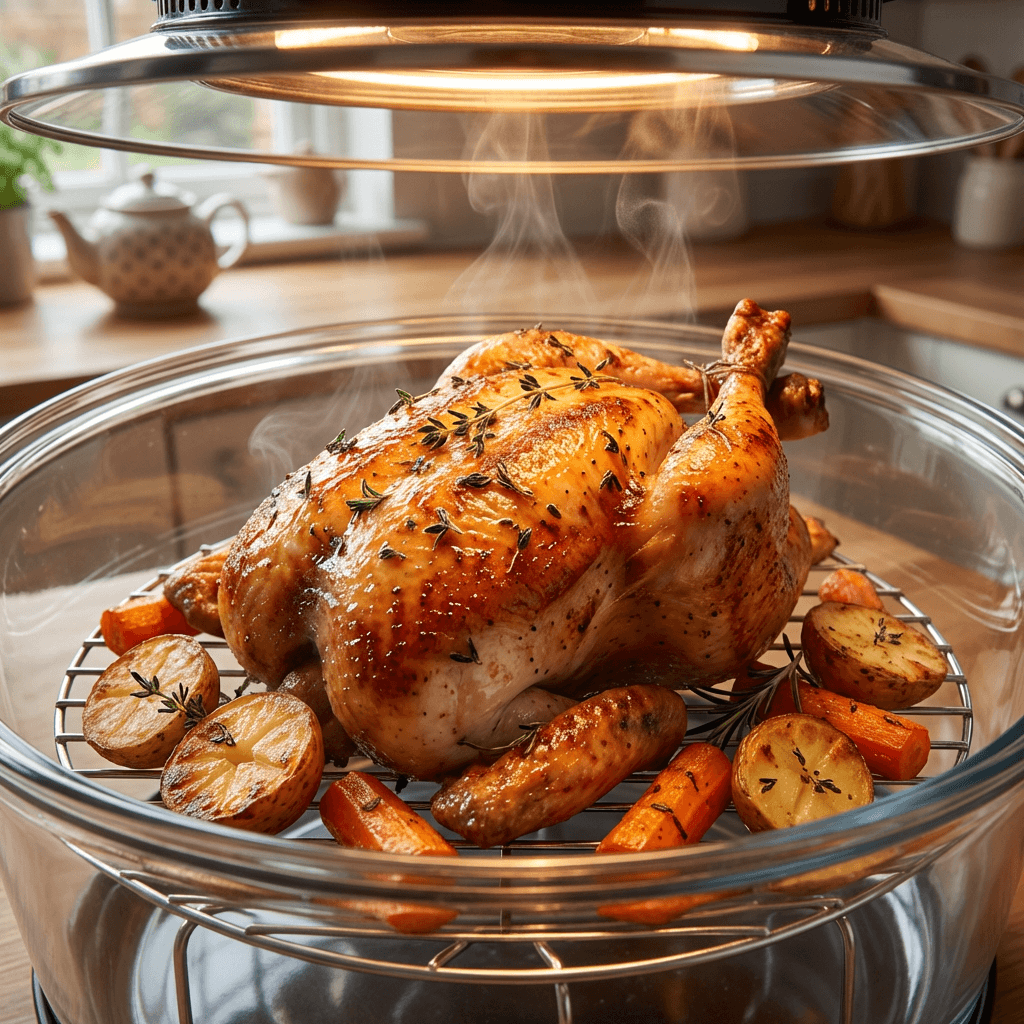
A traditional halogen oven has a transparent glass bowl and a heating unit in the lid. A halogen element supplies heat, while a fan circulates hot air around the food. The controls let you set the cooking temperature and time.
The glass makes it possible to watch the surface of your food as it browns. That can feel reassuring when you are learning a new appliance.
Product names can be confusing. Retailers sometimes describe glass-bowl cookers as halogen air fryers, while other countertop ovens use different heating systems. Look at the actual design and specification rather than relying on the headline.
Ask yourself what you expect it to do. Roasting vegetables, baking potatoes and preparing a small ovenproof dish are different priorities from cooking several large trays at once.
Write down three meals you already enjoy. Those meals provide a better starting point than a long list of advertised functions.
2. Choose Capacity Around Your Meals
Look beyond the number of litres
You may see descriptions such as 12 litres, or 12–17 litres with an extender ring. Check what the quoted maximum actually includes.
An extender ring adds height above the bowl. It does not make the bowl wider. Consequently, the larger headline capacity does not mean you can fit a wider baking dish.
Before ordering, compare the usable internal diameter with your favourite ovenproof dish. Include its handles in the measurement. Also check the available height once the rack and dish are inside.
Two jacket potatoes need a different arrangement from a deep vegetable bake. Think about the shape of your food and cookware, not just the number of people eating.
Avoid buying for an imaginary household
If you usually cook for yourself, choose around ordinary weekday meals. An occasional visit from family does not necessarily justify an appliance that feels cumbersome every day.
Equally, a small cooker is poor value if you repeatedly need several batches. Compare the space needed for your usual portions before deciding.
The useful question is: will this comfortably hold the meal I cook most often?
3. Make the Lid Your First Comfort Check
The lid contains the heating assembly, making its handling particularly important. Picture opening the cooker, reaching for your food and closing it again.
Removable lids
A removable lid needs a planned resting place. Look for a compatible lid stand or the arrangement specified in the manual. Include that space in your kitchen measurements.
Ask the seller for the lid weight if it is missing. The weight of the complete appliance does not tell you how demanding that individual lifting action will be.
Consider the handle shape and whether you can hold it securely with suitable oven gloves. A smooth-looking product photograph cannot answer that question.
Hinged lids
A hinged design may reduce the need to carry the lid elsewhere. However, check the height when fully open and the clearance beneath cupboards.
You should also consider how far you need to reach to open and close it. A hinge does not automatically make every model comfortable for every person.
If grip, shoulder movement or balance affects your cooking, prioritise the handling arrangement over extra programmes. Being over 50 does not mean everyone has the same needs; your own comfort is the deciding factor.
4. Pick Controls You Can Read and Use
Manual controls and digital controls can both work well. The best choice depends on what you find clear.
Manual dials
Two physical dials can offer an uncomplicated routine: set the temperature, then set the timer. Examine the markings closely, including the pointer and the contrast between numbers and background.
Can you tell the difference between nearby settings without leaning over the cooker? Do the knobs appear large enough to grip comfortably?
Digital controls
A digital display may make the selected time or temperature easier to see. Nevertheless, small buttons and multi-step menus can undo that advantage.
Check how to change a setting during cooking. Look for a demonstration of the exact model, rather than assuming all digital versions operate alike.
| Feature | What to check before ordering |
|---|---|
| Temperature control | Readable markings or a clear display |
| Timer | Simple adjustment and an understandable finishing signal |
| Buttons or knobs | Comfortable size and spacing |
| Programmes | Ability to change time and temperature yourself |
| Instructions | Clear explanation of everyday operation |
Try imagining the controls from your normal cooking position. If you cook seated, check whether the display and bowl contents will be visible from that height.
5. Measure the Whole Working Area
A cooker can fit on the worktop and still be awkward to use there. Measure the complete footprint, including the base and handles, rather than the bowl alone.
Then allow for the opening lid, its resting place if needed, and a clear area for an ovenproof dish when serving.
Check the manufacturer’s required clearance around and above the appliance. Do not assume that a gap suitable for one model applies to another.
Also check cable length and socket position. The planned location should let you operate the cooker without stretching the lead across the preparation area.
A helpful approach is to mark out the proposed footprint with paper while the worktop is cold and clear. Place your usual serving dish alongside it. Can you still prepare food comfortably?
If you intend to store the oven after each use, consider the whole lifting routine. A permanent position may suit you better than repeatedly moving a bulky appliance.
6. Think About Cleaning Before You Buy
Cleaning is part of ownership, not a minor detail to consider after delivery. Imagine the bowl at your sink, with the racks waiting beside it.
Ask about the empty bowl weight and whether it fits in the washing-up area. Think about where you will drain and dry it too.
Check which parts the manufacturer permits in a dishwasher. A glass bowl and an electrical heating lid require different treatment; never assume the entire appliance is washable in the same way.
Some models advertise a wash or self-clean setting. Read the instructions to see exactly what that means. Treat it as a cleaning aid rather than assuming it removes every mark or eliminates handling.
The electrical lid must not be immersed. Follow the model’s cooling and cleaning instructions, including any guidance on the glass bowl. device.report
If cleaning already feels impractical during your research, take that concern seriously. You are choosing the entire cooking routine, including washing up.
7. Prioritise Accessories You Will Actually Use
An impressive accessory count is less useful than a few well-designed essentials. Start with the items required for your normal meals.
Racks
Check which rack heights are included and how they fit inside the bowl. You want the arrangement recommended for your dishes, with space to retrieve them comfortably.
Lid support
For a removable-lid model, confirm the approved way to support the lid when it is off the bowl. If a stand is supplied separately, check compatibility and include its cost.
Tongs and gloves
Examine the supplied lifting tools rather than assuming they will suit your hands. A tool that looks adequate in a photograph may feel awkward when holding a loaded rack.
Allow room in your budget for suitable oven gloves if you need them. Judge grip and dexterity as well as heat protection.
Extender rings and additional dishes
An extender ring is useful only when the extra height suits your cooking. Ask whether the dishes you already own fit before ordering specialist accessories.
Start with essentials. After a few weeks of real meals, you will have a much clearer idea of which extras would help.
8. Treat Energy-Saving Claims Carefully
A halogen oven may offer a convenient alternative to heating a larger oven for a small meal. However, a fixed percentage saving is not something to assume for every household.
Energy Saving Trust explains that appliance choice and portion size affect cooking costs. Its air-fryer comparisons should not be treated as proof of identical savings from a halogen oven. Energy Saving Trust
Compare the energy needed for the complete meal, including preheating and any extra batches.
You can estimate an illustrative running cost using:
Power in kilowatts × time in hours × electricity price per kWh.
For example, suppose an appliance draws 1.3 kW continuously for 30 minutes and your electricity costs 25p per kWh:
1.3 × 0.5 × £0.25 = £0.1625, or approximately 16p.
These are example figures, not a current tariff or a measured product result. Thermostat cycling means actual consumption may differ from continuous rated-power use.
A higher wattage also does not automatically mean a higher cost per finished meal: cooking duration matters. If you already own an efficient small cooker, consider whether a second appliance adds enough practical benefit to justify buying it.
9. Check Support, Spare Parts and Returns
Before paying, look for the exact model number, a downloadable manual and clear seller contact details. Save the listing and your order confirmation.
Ask whether a replacement bowl, rack or compatible lid support can be purchased. If heating-unit repair is relevant to your decision, ask the manufacturer about authorised servicing rather than assuming a bulb is suitable for home replacement.
Read the guarantee terms, including any registration requirement. Keep the purchase receipt somewhere easy to find.
For most online goods bought from a UK business, you generally have 14 days after delivery to notify the seller that you wish to cancel, followed by another 14 days to return them. Handling beyond what would reasonably be allowed in a shop can affect the refund. Faulty-goods rights are separate. GOV.UK
Read the return procedure before cooking in the appliance, and check who pays return postage for a change-of-mind return.
Clear support is part of value. A slightly cheaper listing can lose its appeal if basic questions remain unanswered.
10. Use Reviews to Investigate Specific Questions
Customer reviews are most useful when you know what you are trying to learn. Search for comments about lid weight, readable controls, cleaning and customer service.
Pay attention to people describing meals similar to yours. Someone cooking small vegetable dishes may reveal more useful details for your routine than someone discussing large family roasts.
Check that the review refers to the same model and variant. Shared listings can make that surprisingly unclear.
Look for repeated patterns, but keep individual experiences in perspective. One enthusiastic review does not establish long-term reliability, and one complaint does not explain how every unit performs.
Photographs showing the appliance beside everyday kitchen items can help you understand its size. Use them alongside the specification, not instead of it.
11. Three Sensible Buying Approaches
Option 1: Keep everyday cooking simple
Prioritise clear controls, comfortable lid handling and the racks required for your regular meals. This approach suits someone who wants straightforward operation and has little interest in programmes.
Option 2: Put handling first
Compare opening mechanisms, component weights, reach and cleaning arrangements before comparing capacity. This is useful whenever physical comfort strongly affects how often you cook.
Option 3: Choose around existing cookware
Measure a favourite small baking dish and shortlist models that accommodate it properly. This approach suits someone who already knows which oven meals they want to make.
None of these approaches requires choosing the most expensive model. They simply give you a practical reason for selecting one appliance over another.
Your Before-You-Order Checklist
Before clicking Buy, make sure you can answer yes to these questions:
- Have I checked the exact model and heating system?
- Will my usual meal and cookware fit?
- Can I manage the lid comfortably?
- Are the controls readable from my cooking position?
- Is there enough space for opening and serving?
- Have I checked ventilation clearance and cable length?
- Can I wash and store the removable parts?
- Are essential accessories included or budgeted for?
- Are support and returns information clear?
If something is uncertain, ask the seller before ordering. Specific questions are more useful than trying to guess from promotional photographs.
Frequently Asked Questions
What size halogen oven is best for one or two people?
Compare the usable bowl dimensions with your usual portions and dishes. An expandable model may offer flexibility, but the largest litre figure alone does not establish a good fit.
Is a hinged lid better than a removable lid?
A hinged lid may reduce carrying, while a removable lid needs an approved resting arrangement. Check reach, opening height and your own comfort before choosing.
Are manual controls better for people over 50?
Not automatically. Some people prefer physical dials; others find a clear digital display easier. Readability and straightforward adjustment matter more than age-based assumptions.
Does an extender ring increase the bowl width?
No. It adds height above the existing bowl. Check dish diameter separately rather than assuming the expanded capacity accommodates wider cookware.
Should I buy a halogen oven if I already own an air fryer?
Only if it solves a practical problem, such as accommodating a favourite dish or providing a cooking arrangement you prefer. Identify that benefit before spending money.
Choose the Oven That Makes Dinner Easier
The best halogen oven for your household is one you can comfortably open, operate, clean and use for meals you enjoy. Clear controls and manageable handling deserve as much attention as price and capacity.
Start with three familiar meals, measure your kitchen and cookware, then compare a small shortlist. That gives you a useful buying decision grounded in everyday life.
For your next step, explore our halogen oven model comparison, using this checklist to assess the features relevant to you. Recheck current specifications and seller details before ordering.
Want more practical ideas for easier cooking after 50? Explore the Fifty or More guides and join our newsletter for new kitchen tips and meal inspiration.