Making a cup of tea, warming yesterday’s soup and cooking dinner for two should feel simple. Yet it is surprisingly easy to use more electricity, buy more food and create more washing-up than the meal requires.
After 50, your kitchen routine may change. Perhaps the children have moved out, you are working different hours, or you simply want good meals with less effort. Your appliances should fit the way you live now.
The best appliances for saving money in the kitchen after 50 are the ones that earn their place through regular, useful work. A smaller cooking space can help with individual portions. A freezer can protect tomorrow’s dinner. A familiar microwave might already offer the improvement you need.
This guide compares practical options for UK households, including halogen ovens, steamers and everyday essentials. The recommendations are based on their suitability for different routines, rather than a laboratory ranking of particular models.
Which Kitchen Appliances Are Worth Considering First?
Start with the meals you actually eat. Someone reheating homemade lunches needs a different solution from someone preparing several dinners at once.
| Appliance | Worth considering for | Main question before buying |
|---|---|---|
| Microwave | Reheating individual meals | Could your existing microwave do more? |
| Air fryer | Small portions with a crisp finish | Will dinner fit without separate batches? |
| Halogen oven | Countertop roasting and baking | Can you handle the lid and bowl comfortably? |
| Electric steamer | Coordinating vegetables and meal components | Will you use the available tiers? |
| Slow cooker | Planned soups and casseroles | Do you enjoy preparing food ahead? |
| Electric pressure cooker | Regular one-pot cooking | Will its functions replace other cooking jobs? |
| Kettle | Everyday hot drinks | Can you measure and pour easily? |
| Fridge-freezer | Food storage and planned leftovers | Is its capacity right for your household? |
These are starting points, not a shopping list. Choose the tool that solves your most frequent problem.
Understand Running Costs Before Comparing Appliances
An appliance’s wattage describes power, not the final cost of dinner. Time matters too, and many heating appliances cycle on and off.
For a rough calculation, use:
Power in kilowatts × hours used × electricity price per kWh = cost.
Suppose a hypothetical appliance draws 1 kW continuously for 30 minutes. It uses 0.5 kWh. At an illustrative electricity rate of 30p per kWh, that session costs 15p.
This is a worked example, not a current UK tariff or a prediction for your appliance. Use the unit rate on your own bill. A microwave’s advertised cooking output may also differ from its electrical input.
For compatible plug-in appliances, a correctly rated energy monitor can help compare complete cooking sessions. Include preheating and any second batch. Compare the same quantity of food, cooked to the same standard.
Your standing charge remains payable regardless of which appliance makes dinner. Reduced consumption affects the usage part of the bill.
1. Microwave: A Sensible Starting Point for Smaller Meals
Before buying anything new, reconsider your microwave. Energy Saving Trust identifies microwaves as a useful choice for reheating and quick cooking, while larger ovens can suit batch cooking better. energysavingtrust.org.uk
Think beyond ready meals. Your weekly menu might include reheated lentil soup, porridge, vegetables in a suitable covered container, or a potato prepared according to a reliable microwave recipe.
For a smaller household, the practical advantage is flexibility: heat one serving when you want it, without turning every lunch into another cooking project.
Look for readable controls, an easy door release and enough room for your usual plate. Check that you can lift a hot bowl out without stretching or reaching above a comfortable height.
The cheapest improvement may be learning two useful settings on the machine you already own. A complicated replacement brings little value if the familiar one handles your everyday meals.
2. Air Fryer: Consider It for Compact, Crisp Meals
An air fryer deserves consideration if you frequently cook small amounts of food that you want browned or crisp. Energy Saving Trust highlights its suitability for one or two people compared with heating a larger oven for the same small meal. energysavingtrust.org.uk
The buying decision depends on usable space. Basket capacity in litres does not necessarily tell you whether two portions can sit comfortably in the arrangement your recipe requires.
Picture an ordinary dinner before choosing a model. Will your potatoes and vegetables fit? Will you need another appliance alongside it? Would a second batch leave the first portion waiting?
Check the loaded basket’s weight and the effort needed to remove it. Cleaning matters too: an appliance you dread washing may gradually disappear from your routine.
If you already own a countertop cooker that handles these meals well, test that first. Another machine needs a clear purpose.
3. Halogen Oven: Assess the One You Already Have
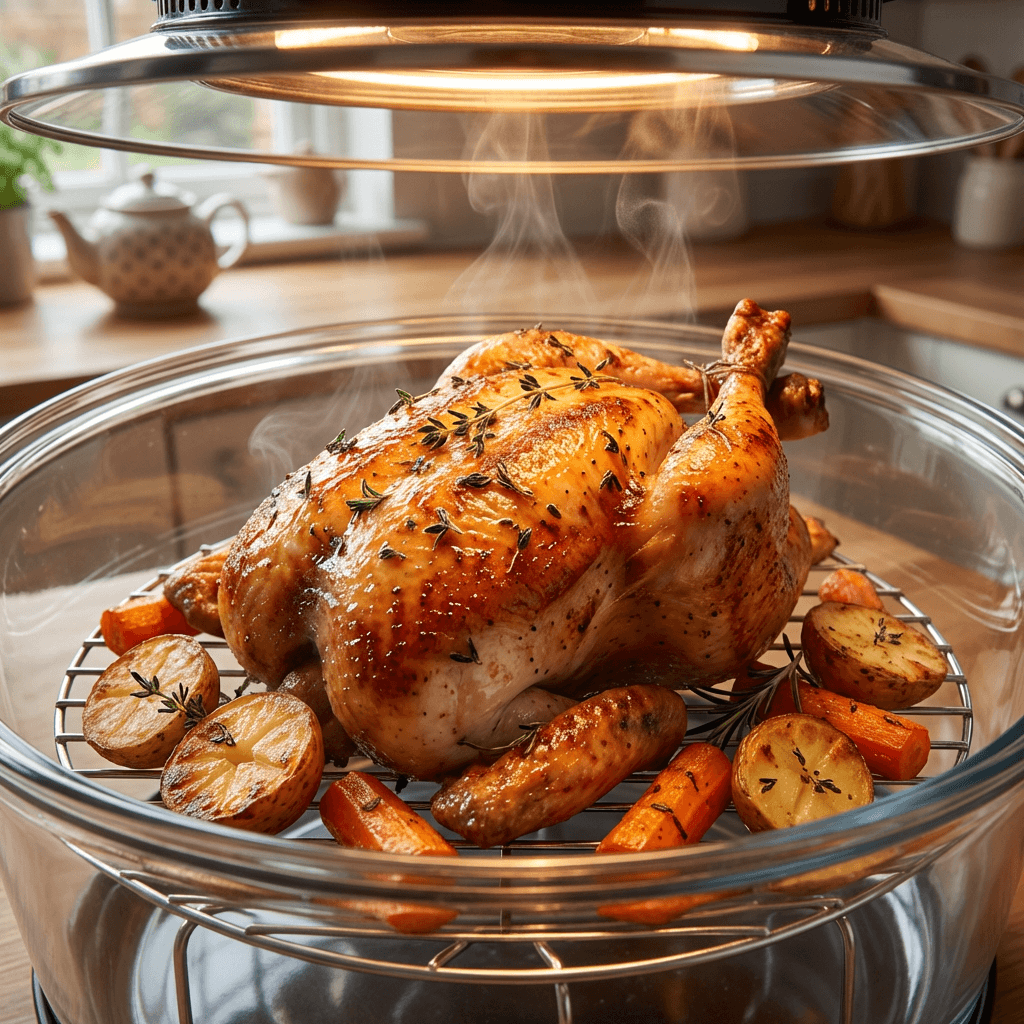
A traditional halogen oven usually has a glass bowl, a heating lid and racks inside. For readers who already enjoy using one, it belongs in the comparison rather than being forgotten when newer gadgets appear.
Build the decision around your own cooking. Can it prepare your usual roasted vegetables, small bake or evening meal in one session? Can you use it without also heating the main oven?
Do not assume a particular percentage saving. Compare your complete cooking process, including any preheating, finishing and additional batches. That is an assessment method, not a claim that every halogen oven beats every conventional oven.
Handling deserves particular attention. Consider where the hot lid will rest, whether the controls are readable and whether you can clean the cooled bowl comfortably.
My recommendation is to keep using a suitable existing halogen oven before buying an overlapping appliance. Familiar equipment can be valuable when it already fits your meals.
4. Electric Steamer: Useful When Meals Come Together
Consider a steamer if vegetables, potatoes and other steamed foods appear regularly on your menu. Its appeal is the possibility of organising compatible components around one appliance.
For example, you might plan potatoes and vegetables together, adding ingredients at the stages specified by a suitable recipe and your appliance manual. The goal is a repeatable meal you enjoy making.
This does not establish that steaming is always the cheapest method. A single portion may be easier to prepare with equipment already available. Compare the whole meal, including any separate browning or finishing step.
Before buying, inspect the water indicator, timer and handles. Imagine removing a filled tier and setting it down safely. Storage space for the baskets also matters.
Choose it because steamed meals fit your habits. A practical routine is more persuasive than buying a steamer with the vague intention of using it eventually.
5. Slow Cooker: Match It to Planned Meals
A slow cooker is worth considering if you like preparing food earlier and having a meal ready later. Energy Saving Trust describes it as useful for preparing several meals’ worth of food together. energysavingtrust.org.uk
Think about the dishes you would genuinely repeat: vegetable casserole, a suitable lentil recipe or a familiar soup. Write three ideas down before choosing the appliance’s size.
Avoid comparing its hourly wattage with another cooker’s wattage and stopping there. Several hours of operation still count. The relevant comparison is the complete dish and how many portions you actually eat.
Also consider the filled insert. Can you lift it comfortably, serve from it and wash it afterwards? A smaller model may suit your routine better than one chosen for occasional entertaining.
Follow a reliable recipe and the manufacturer’s instructions. Treat any additional preparation and keeping-warm time as part of the routine you are evaluating.
6. Electric Pressure Cooker: Buy for Repeated Jobs
An electric pressure cooker may appeal if you regularly prepare one-pot dishes and want to change a cooking routine that currently takes substantial attention. Energy Saving Trust includes pressure cooking among options for reducing cooking time. energysavingtrust.org.uk
However, a programme labelled with a short cooking time does not necessarily describe the whole session. Check the manual for preparation, pressurising and pressure-release requirements before planning dinner around it.
Ask what it would replace in your kitchen. Would you use it for several familiar recipes each week, or mainly experiment during the first month?
Inspect the lid, sealing components, display and cleaning instructions. Compare the everyday function you need with the extra modes included in the price.
For an occasional recipe, the purchase may be difficult to justify. For a regular cooking task, it deserves a proper comparison with your existing method.
7. Kettle: Make Measuring Easy
The kettle is a good reminder that changing a habit can be more useful than changing a product. Energy Saving Trust recommends boiling only the amount of water needed. energysavingtrust.org.uk
If your current kettle works well, practise filling it for your usual mug while respecting the manufacturer’s minimum level. A clearly visible water window can make that habit easier.
When replacement is necessary, check balance, handle comfort, lid opening and pouring control. Try to assess the kettle with water weight in mind, rather than judging the empty display model alone.
A large capacity is useful only if you need it. Equally, a smaller kettle is not automatically easier for everyone to handle.
Variable temperature controls may be useful for drinks you already prepare that way. Avoid paying for settings that add complexity without serving your routine.
8. Fridge-Freezer: Compare Storage and Running Costs
If you need to replace a fridge-freezer, compare its energy consumption as well as its size. Energy Saving Trust explains that energy labels help compare appliances, and that capacity matters alongside the letter rating. energysavingtrust.org.uk
Read the stated annual kWh figure for refrigerators and freezers. Multiply it by your electricity unit price to estimate the electricity cost under the label’s test conditions. Actual use can differ.
An illustrative difference of 100 kWh per year would be £30 annually at 30p per kWh. If the more efficient option costs £150 extra, that difference alone takes five years to recover, assuming unchanged consumption and tariff.
Storage must also work for you. Can you reach the shelves, see what is available and remove drawers comfortably? A freezer full of forgotten portions does little for your meal budget.
Replacement should follow a comparison of condition, repair options, purchase price and likely use, rather than the energy rating alone.
What About the Dishwasher?
If you already own one, include it in your weekly review. Energy Saving Trust recommends running dishwashers with full loads. Follow the loading instructions so water can reach the dishes, and select a programme suitable for the load. energysavingtrust.org.uk
If you are comparing replacements, energy labels show dishwasher consumption per 100 eco cycles, rather than annual consumption. Calculate costs using a realistic annual number of cycles for your household. A machine that fits your daily crockery and is comfortable to load deserves consideration alongside its purchase price. energysavingtrust.org.uk
Calculate Whether a New Appliance Will Pay for Itself
Small savings become useful through repetition. They also need to cover the purchase price if saving money is your main reason for buying.
Imagine a £60 appliance that saves a measured 15p on a meal you make four times each week. The illustrative annual saving is:
£0.15 × 4 × 52 = £31.20.
Recovering £60 would take roughly 100 weeks. That assumes you keep using it as planned, the saving remains the same and there are no additional costs.
If it saves only 5p per meal at that frequency, annual savings fall to £10.40. The purchase then takes nearly six years to recover through electricity savings alone.
Convenience may still justify the purchase. Just give it its own value instead of counting it as money already saved.
Choose Controls and Handling That Suit You
Being over 50 does not mean everyone needs the same kitchen. Some readers prioritise speed; others want less lifting, clearer controls or equipment that is easy to use while seated.
Before buying, rehearse the whole job: filling, loading, starting, serving, cooling and cleaning. Imagine where each hot component goes and whether you need to move the appliance between uses.
Ask yourself:
- Can I read the settings in ordinary kitchen light?
- Can I open it and remove food comfortably?
- Is there a stable, accessible place for it?
- Can I clean its removable parts without difficulty?
- Will it remain accessible after the novelty wears off?
A machine stored behind several other appliances has an extra barrier to regular use. Include that reality in your decision.
Make Batch Cooking Work With Food Storage
If you prepare extra portions, decide where they will go before cooking. Clear space, find suitable containers and label the meals so that future lunches are easy to identify.
Food Standards Agency guidance advises keeping the fridge between 0°C and 5°C and the freezer around −18°C. Cool cooked food promptly, refrigerate within one to two hours, and eat refrigerated leftovers within 48 hours or freeze them. Follow any stricter food-specific guidance. www.gov.uk
When reheating, heat leftovers until steaming hot throughout and reheat them only once. Stir or turn food where appropriate to help avoid cold areas, particularly in a microwave. www.gov.uk
Make portions match your appetite. The aim is to retrieve a meal you want, not a large frozen block that creates another round of leftovers.
Try a Seven-Day Kitchen Savings Check
Before spending, keep a simple record for one week. Note what you cooked, the portions, the appliances used and anything thrown away.
Highlight repeated frustrations: a nearly empty oven, a difficult basket, unused ingredients or lunches bought because nothing convenient was ready.
Choose one change for the following week. It might be reheating a homemade lunch, planning an existing freezer portion or comparing two methods for your usual dinner.
Then decide whether there is still a problem that requires a purchase. This gives your shopping decision a real task to solve.
Frequently Asked Questions
What Is the Cheapest Appliance for Cooking for One?
There is no universal winner. For a quick reheat, consider your microwave. For a crisp meal, compare your available countertop cooker with your oven. Include the entire session and the portion you need.
Should I Replace My Halogen Oven With an Air Fryer?
Only if the change solves a clear problem. Compare capacity, handling, cleaning and your actual cooking process. Keeping a useful appliance avoids another purchase.
Does Lower Wattage Guarantee a Lower Bill?
No. Running time matters, and thermostats can change consumption during cooking. Compare energy used for the completed meal rather than wattage alone.
Which Appliance Should I Buy First?
Start with your most common unmet need. If existing equipment already covers it comfortably, improve the routine first. Buy when the purpose and likely use are clear.
Build a Kitchen That Works for Everyday Life
The best appliances for saving money in the kitchen after 50 fit your portions, preferences and budget. Choose one useful improvement, check the full cost and make everyday cooking easier to repeat.
Which appliance earns its place in your kitchen, and which one spends most of its time in the cupboard? Share your experience below.